1. What is Laser Welding
In modern high-precision manufacturing—spanning automotive battery packs, aerospace components, medical implants, and custom sheet metal enclosures—achieving strong, hermetic, and cosmetically clean seams is essential. Traditional thermal joining processes like TIG or MIG welding often introduce excessive heat input, leading to part warpage, heavy post-weld grinding, and wide heat-affected zones (HAZ).
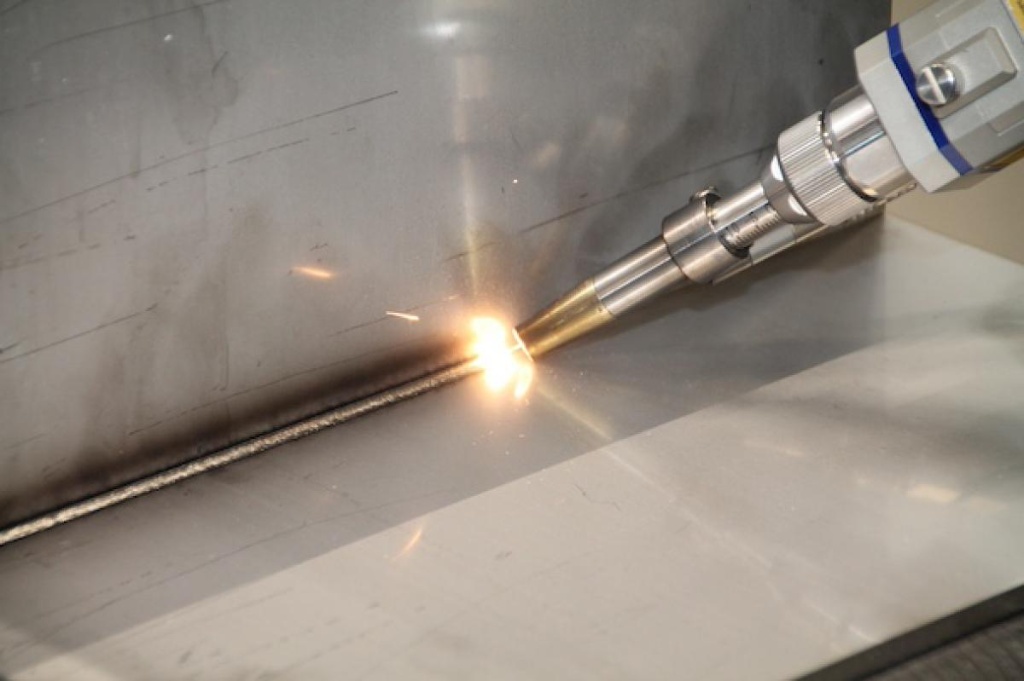
The answer is Laser Welding (Laser Beam Welding, LBW). As a high-energy-density non-contact joining process, laser welding uses a highly focused laser beam to melt metallic or thermoplastic workpieces at microscopic scales, creating deep, narrow welds with minimal distortion at ultra-high speeds.
2. How Does Laser Welding Work? Keyhole vs. Conduction Mode
The fundamentals of laser beam welding center on concentrating monochromatic, coherent light onto a targeted surface joint. Depending on the power density applied to the material, laser welding operates in two distinct physical modes:
- Conduction Mode Welding (< 10⁵ W/cm²): At lower energy densities, the laser energy is absorbed purely by the material surface, and heat conducts downward into the joint. This creates shallow, wide, smooth welds with a high aesthetic finish, making it ideal for thin-walled parts, electronic sealings, and cosmetic outer seams.
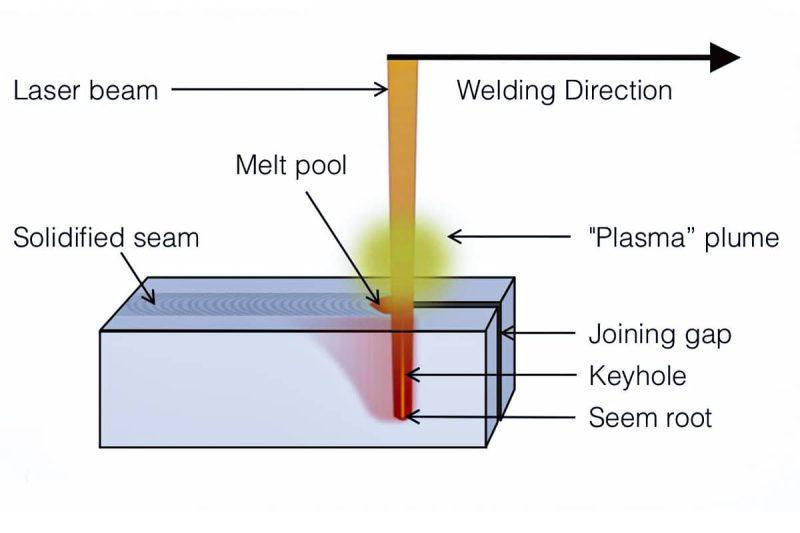
- Keyhole Mode Welding (> 10⁶ W/cm²): At higher energy densities, the beam rapidly vaporizes the metal, forming a narrow vapor cavity (“keyhole”) that penetrates deep into the material. The keyhole absorbs over 90% of the laser beam power, allowing for extremely high depth-to-width ratios (up to 10:1 or more) and rapid joining of thick structural sections in a single pass.
3. Key Advantages: Why Choose Laser Welding?
Laser welding has rapidly evolved into a primary joining technology across automated factory floors due to several critical processing capabilities:
- Minimal Thermal Distortion & Narrow HAZ: Concentrated power input ensures that heat stays strictly localized. The minimal Heat-Affected Zone (HAZ) prevents thin sheet metal warpage and thermal stress cracking.
- High Processing Speeds: Fiber lasers enable welding speeds up to 5 to 10 times faster than conventional arc welding, substantially lowering cycle times in mass production.
- Non-Contact & High Accessibility: Because no physical electrode touches the workpiece, welds can be performed in tight recesses, angled joints, or through transparent shielding windows.
- Exceptional Aesthetic & Clean Seams: Laser welds produce little to no spatter, eliminating the need for labor-intensive post-weld grinding, pickling, or polishing.
4. Laser Welding vs. Traditional TIG / MIG Welding
When selecting a joining methodology for precision fabrications, design and manufacturing engineers must weigh laser welding against traditional electric arc methods like TIG (GTAW) and MIG (GMAW):
| Comparison Dimension | Laser Welding (LBW) | TIG / MIG Arc Welding |
| Heat Input & Distortion | Extremely low heat input; minimal part distortion | High heat input; widespread thermal warping |
| Welding Speed | Ultra-fast (e.g., 2–8 m/min on thin sheets) | Moderate to slow (manual/semi-automated) |
| Fit-Up & Joint Tolerance | Tight tolerances required (< 10% sheet thickness gap) | Forgiving gap tolerance; easy filler wire feeding |
| Post-Processing Cost | Near zero; clean, smooth, slag-free seams | High; requires grinding, wire brushing, or descaling |
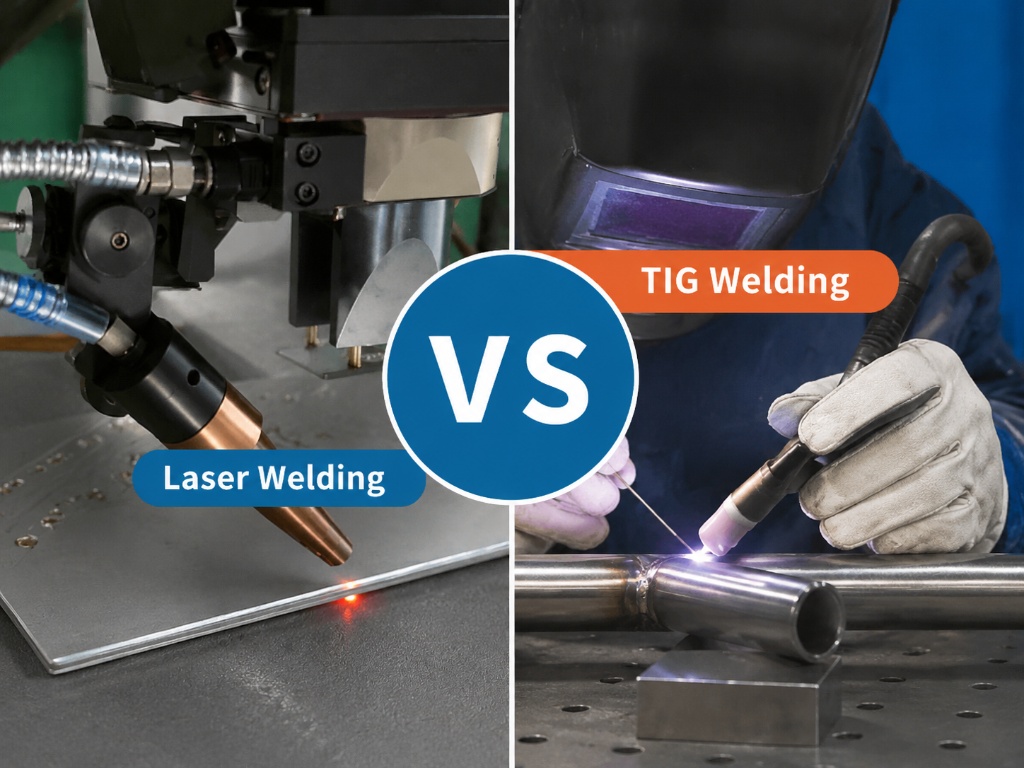
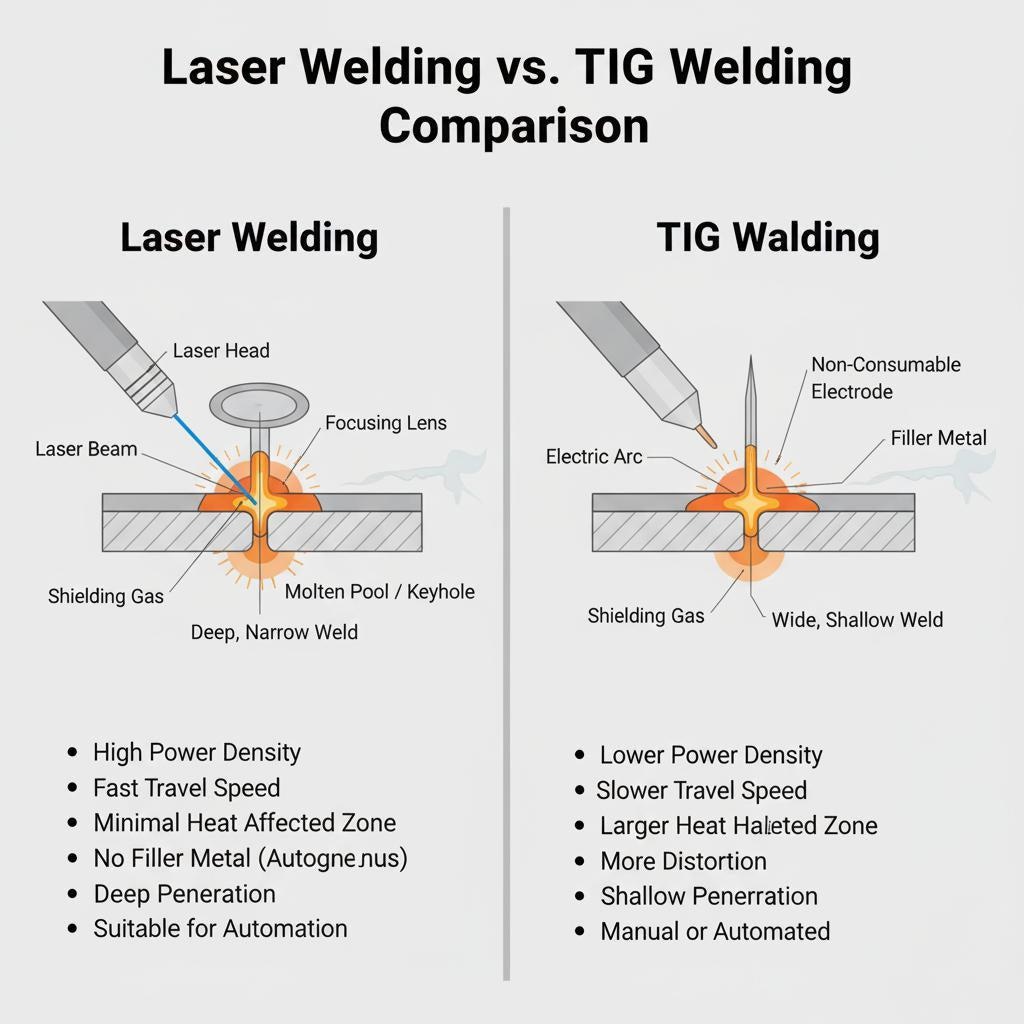
Procurement Tip: Choose TIG / MIG Welding when joining heavy structural steel sections with large fit-up gap variations. Choose Laser Welding when joining cosmetic stainless enclosures, thin-gauge sheet metal, dissimilar metals, or high-volume precision components where distortion must be zero.
5. Common Industrial Applications
Laser beam welding is ubiquitous across high-tech advanced manufacturing industries:
- Automotive & EV Manufacturing: Battery cell busbars, EV pack enclosures, transmission gears, body-in-white (BIW) panels, and tailored blanks.
- Medical Device Fabrication: Hermetic seals for pacemakers, surgical tools, endoscopes, and titanium implants.
- Precision Electronics & Hardware: Sensor housings, relay cans, phone chassis frames, and custom CNC sheet metal enclosures.
- Aerospace & Defense: Turbine blade repairs, thin-skin titanium ducting, and fuel tank assemblies.
Frequently Asked Questions
Yes. While aluminum and copper reflect NIR fiber lasers (1070 nm wavelength) at room temperature, modern high-brightness fiber lasers, green lasers (532 nm), or blue lasers (450 nm) overcome reflectivity issues, allowing defect-free, spatter-free welds on copper busbars and aluminum battery cells.
Because the focused laser spot size is small (typically 0.1 to 0.6 mm), joint gaps should ideally be less than 10% of the thinner sheet thickness. When joint gaps are larger, wobble laser heads or wire-feed attachments are used to bridge the gap successfully.
Yes, inert shielding gases (such as Argon, Nitrogen, or Helium) are typically required to prevent molten metal oxidation, shield optical components from spatter, and suppress plasma plume formation during deep-penetration keyhole welding.
Keyhole instability is the primary cause of porosity when trapped vapor bubbles fail to escape before solidifying. Weld cracking often stems from excessive rapid cooling rates or improper alloy selection, which can be mitigated by preheating, beam shaping, or using proper filler wire.
Yes. Due to precise energy input control, laser welding can join dissimilar material combinations—such as copper to aluminum, steel to nickel, or titanium to stainless steel—by controlling intermetallic compound formation.
Absolutely. Modern handheld fiber laser welders and highly flexible CNC/robotic laser stations allow quick switching between fixtures, making laser welding cost-effective for both rapid prototyping and full mass production.