1. H62 vs H65: Main Differences
H62 and H65 are two commonly used brass grades in metal stamping, sheet metal fabrication, electrical parts and decorative components. The main difference is copper content. H62 contains about 62% copper, while H65 contains about 65%. This small difference affects strength, ductility, bending and stamping performance.
| Property | H62 Brass | H65 Brass |
|---|---|---|
| Copper Content | 60.5–63.5% | 63.0–68.5% |
| Strength | Generally higher | Moderate |
| Ductility | Good | Better |
| Cold Forming | Good | Very good |
| Deep Drawing | Moderate | Better |
| Cost | Usually lower | Usually slightly higher |
In simple terms: H62 = strength + economy, H65 = ductility + better formability.
For engineers and buyers, the key question is not which material is better, but which material is more suitable for the part and manufacturing process.
2. H62 and H65 Equivalent Grades Worldwide
H62 and H65 are Chinese GB designations. Similar brass materials use different names in other countries and regions.
| Standard / Country | H62 – Closest Comparable Grade | H65 – Closest Comparable Grade |
|---|---|---|
| China – GB | H62 | H65 |
| USA – UNS | C27400 | C27000 |
| Germany – DIN / DIN EN | CuZn37 / CW508L | CuZn36 / CW507L |
| Japan – JIS | C2720 | C2700 |
| ISO | CuZn38 | CuZn35 |
Important: These are approximate equivalents, not always direct replacements. Chemical composition, temper and mechanical-property requirements should be checked before changing material standards.
3. H62 Brass for Stamping & Sheet Metal Fabrication
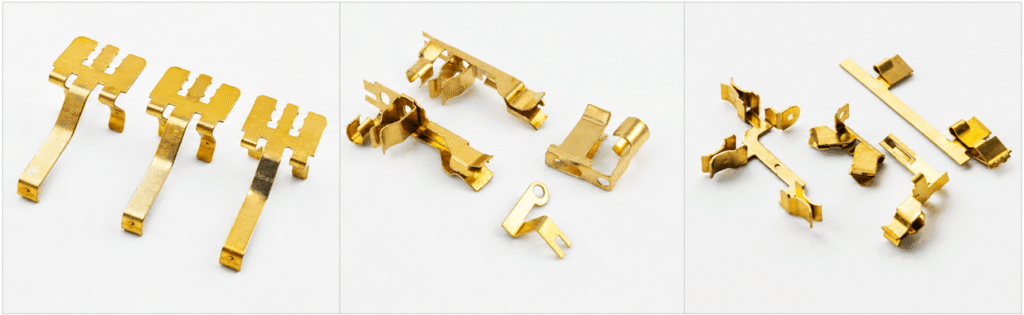
H62 offers a good balance between strength, formability and cost, making it suitable for general stamping. Typical applications include:
- brackets and washers
- electrical hardware
- clips
- decorative parts
- general stamped components
For blanking, punching, shallow forming and simple bending, H62 is usually a practical choice. If the part geometry is relatively simple, there may be little reason to use a higher-copper brass.
4. H65 Brass for Complex Forming
H65 generally provides better ductility and cold-forming performance. It is more suitable for parts involving:
- multiple bends
- smaller bend radii
- flanging
- embossing
- deeper drawing
- complex stamped geometry
H65 is widely used for deep-drawn parts, stamped parts and connectors because of its cold-forming capability. For mass production, better formability can reduce the risk of edge cracking and forming failure.
FAQ
H62 contains less copper and generally offers higher strength and lower material cost. H65 contains more copper and provides better ductility and cold-forming performance.
H62 is a Chinese GB brass grade. Common approximate international references include CuZn37/CuZn38 in Europe and JIS C2720 in Japan. Equivalent grades should always be confirmed according to chemical composition and temper before substitution.
H65 is commonly compared with UNS C27000 in the USA, JIS C2700 in Japan, and CuZn36 / CW507L in Europe.
For general blanking, punching and simple bending, H62 is usually sufficient. H65 is more suitable for parts requiring complex forming, multiple bends or deeper drawing.
H65 generally has better ductility and is more suitable for tight or complex bends. However, material temper, thickness, bend radius and rolling direction also affect cracking risk.
Choose H62 for simple stamped or sheet metal parts where strength and cost are important. Choose H65 when better ductility, tighter bending or more complex forming is required.