1. Why Are Pre-Applied Thread-Locking Screws So Important?
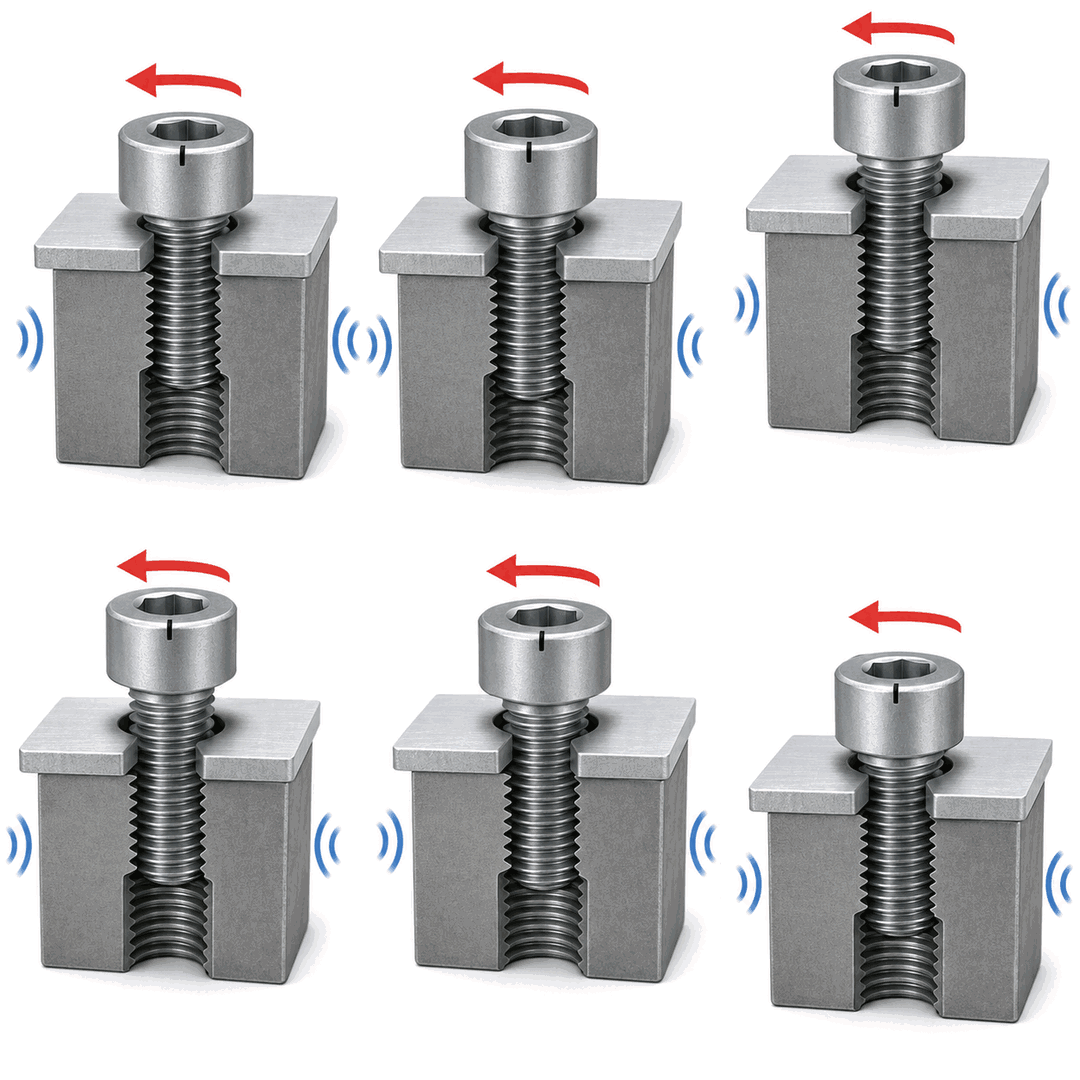
Standard screws may gradually lose clamp load and rotate loose when exposed to continuous vibration, repeated impact, temperature cycling, or settlement of the joint surfaces. Pre-applied thread-locking screws add a locking material to the threads before assembly, increasing resistance to rotation and reducing the risk of noise, connection failure, and loose components.
2. What Are Pre-Applied Thread-Locking Screws?
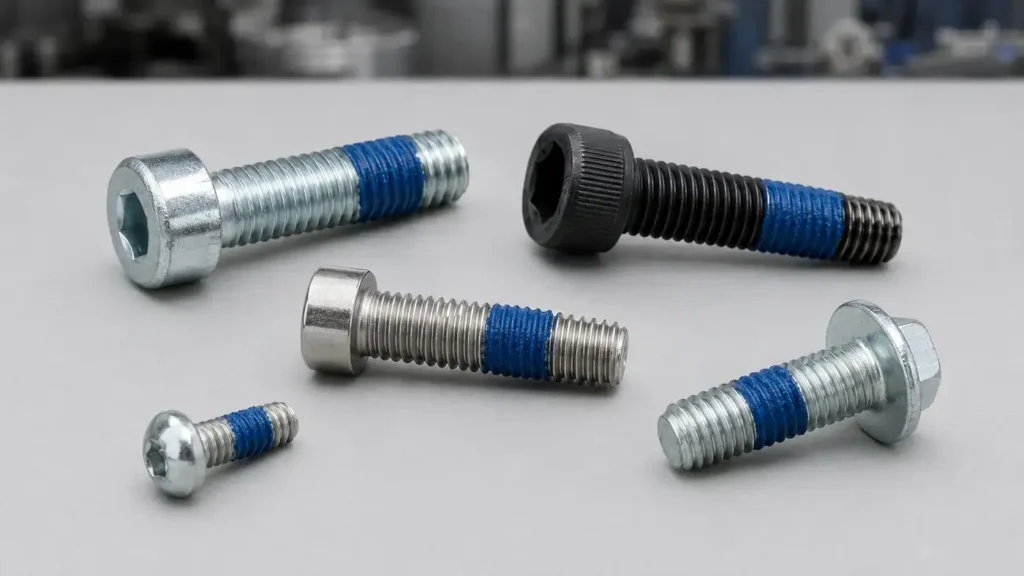
Pre-applied thread-locking screws are fasteners with nylon, engineered polymer, or reactive locking material applied to part of the thread before delivery. They may also be described as pre-coated locking screws, nylon patch screws, or prevailing-torque fasteners, depending on the technology used. The treatment can be applied to pan-head screws, socket-head cap screws, hex bolts, flange bolts, set screws, studs, and some internally threaded fasteners.
Compared with manually applying liquid threadlocker, a factory-applied coating provides more consistent material quantity and placement. The fasteners arrive ready for assembly and are generally suitable for bowl feeders, automatic screwdrivers, and robotic equipment. Coating color should only be used for identification because blue, red, or orange does not provide a universal indication of material, strength, or temperature resistance.
3. Why Do Thread-Locking Screws Resist Loosening?
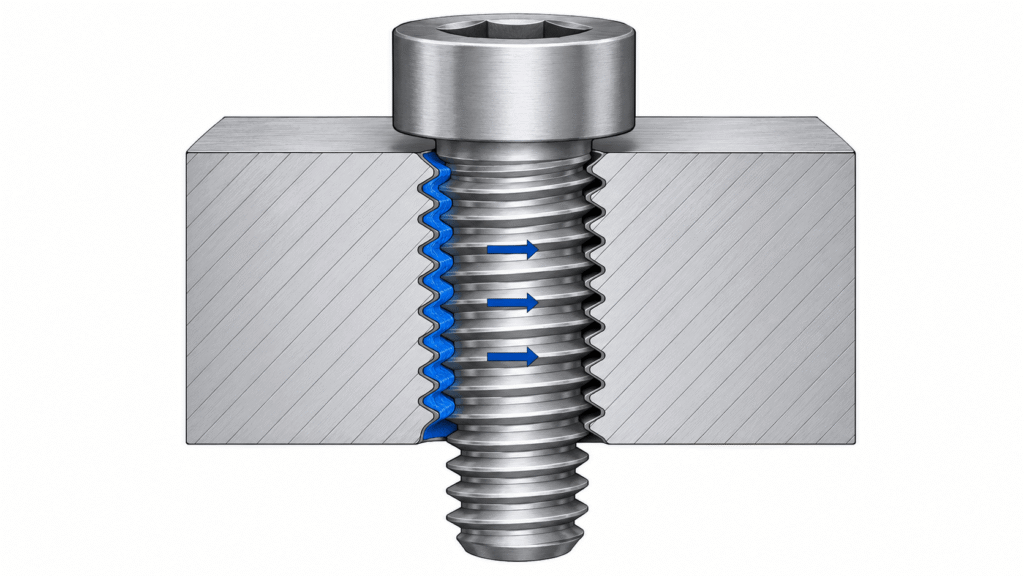
In a mechanical nylon patch system, the polymer is compressed as the screw enters the mating thread. The patch acts as an elastic wedge, pushing the screw toward the opposite side of the tapped hole and increasing metal-to-metal contact between the thread flanks. This creates continuous rotational resistance known as prevailing torque. Mechanical patches act immediately, require no curing, and can often be adjusted or reused.
Reactive coatings use resin, curing agents, or microcapsules that are activated by pressure during installation. The released materials mix, cure, fill the thread clearances, and lock the connection; some products also provide sealing. Reactive coatings normally require curing and usually need to be replaced after disassembly. Neither technology can correct insufficient thread engagement, incorrect tightening torque, inadequate joint stiffness, or unsuitable fastener strength.
4. Common Types of Pre-Applied Thread-Locking Screws
| Common type | Locking method | Curing | Reusability | Best suited for |
|---|---|---|---|---|
| Nylon patch screw | Compressed patch creates a wedge effect and prevailing torque | No | Normally reusable | Adjustable or serviceable connections |
| All-around nylon coating | Polymer surrounds the thread to increase friction and reduce clearance | No | Product-dependent | Connections requiring greater coverage or improved sealing |
| Microencapsulated reactive coating | Capsules break during assembly and the released materials cure | Yes | Normally single-use locking | Severe vibration, higher locking strength, or sealing |
| High-temperature polymer patch | Heat-resistant polymer creates mechanical prevailing torque | No | Verification required | Engines, brakes, heating equipment, and hot environments |
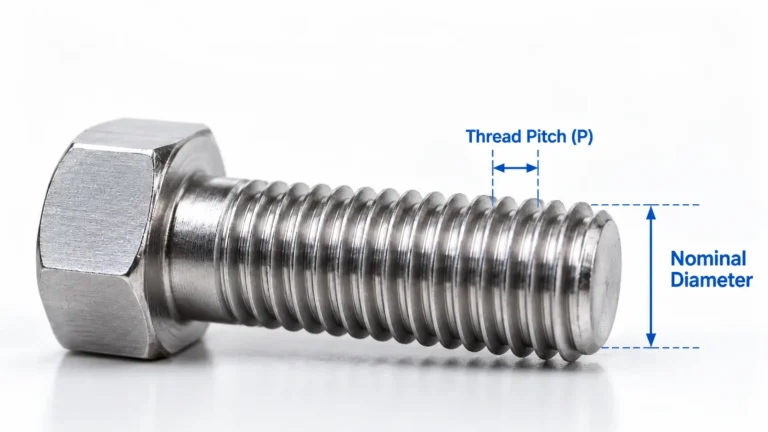
A typical nylon patch leaves approximately two to three lead threads uncoated and covers about four to six thread pitches. Greater circumferential coverage may improve sealing but can also increase installation torque. The patch dimensions must therefore match the fastener size, mating thread, and required torque performance.
For repeated maintenance, a verified reusable nylon patch is normally preferred; for severe vibration or one-time assembly, a reactive coating may be more suitable. Drawings and purchasing specifications should define the coating technology, starting position, length, circumferential coverage, prevailing-on torque, removal torque, permitted reuse cycles, operating temperature, chemical exposure, curing conditions, and acceptance tests instead of stating only “apply blue patch.”
5. Main Applications of Thread-Locking Screws
| Application area | Typical components | Main purpose |
|---|---|---|
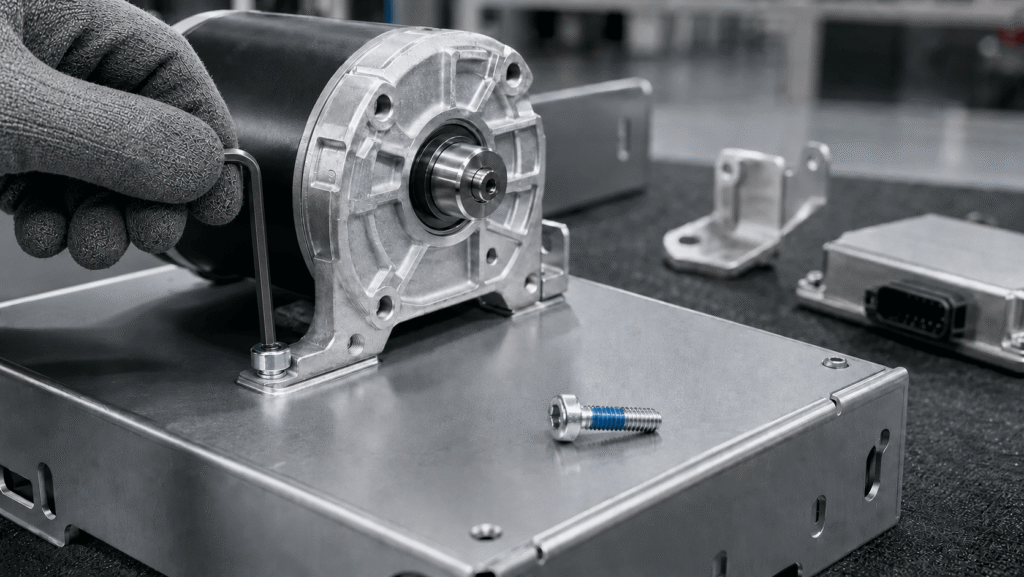
| Motors and power transmission | Motors, fans, pumps, gearboxes, and compressors | Resist continuous vibration and abnormal noise |
| Automotive and transportation | Brackets, seat mechanisms, drivetrain and brake accessories | Withstand road shock, temperature changes, and long-term vibration |
| Sheet metal and industrial equipment | Chassis, cabinets, control boxes, covers, and internal brackets | Prevent loosening during transport and machine operation |
| Electronics and telecommunications | Servers, communication equipment, power modules, and heat sinks | Retain small screws under fan vibration and shipment |
| Appliances and consumer products | Coffee machines, washing machines, furniture, and sports equipment | Improve long-term reliability and reduce servicing |
| Automated assembly | High-volume screws, studs, and nuts | Eliminate manual adhesive application and improve consistency |
During assembly, the internal-thread entrance should have a normal chamfer and be free of sharp burrs that could scrape off the coating. The coated section must enter the effective internal thread completely, and tightening should be controlled with a suitable torque tool. Lubricants or additional threadlocker should not be introduced without validation because friction changes can affect both installation torque and clamp load. Reactive coatings must also receive the specified fixture and full-cure times.
Quality inspection should confirm patch position, length, circumferential coverage, adhesion, and cleanliness. Performance testing should use production-representative mating threads, materials, finishes, and tolerances to measure prevailing-on torque, first removal torque, and the torque retained after the specified reuse cycles. Safety-critical joints may additionally require vibration, thermal cycling, or fluid-aging validation.
FAQ
They serve a similar purpose, but the material is applied in a controlled process before delivery and may use either mechanical or reactive locking technology.
They can normally be reused, but the fastener must continue to meet the specified minimum prevailing torque after each cycle.
A localized patch can generate sufficient wedge force while keeping the lead threads clear for easier starting.
No universal color system applies across manufacturers; use the product specification and torque test results.
Typical nylon patches may operate from approximately −56°C to +120°C, while high-temperature polymers can reach approximately +200°C or higher, depending on the product.
It may simplify some joints, but the change must be validated against clamp load, joint design, vibration, and maintenance requirements.