1. Why Is Coating Adhesion Important?
For powder-coated and painted metal components, a uniform surface finish does not necessarily guarantee reliable coating performance. Poor adhesion can lead to peeling, flaking, or coating separation during assembly, handling, and service. These defects may compromise appearance and reduce the protective function of the coating.
The Cross-Cut Adhesion Test, also known as the Cross-Hatch Test, is a widely used quality inspection method for evaluating coating adhesion on metal substrates. At Innoway Precision, coating adhesion testing helps verify surface finishing quality and identify potential process issues before products are delivered to customers.
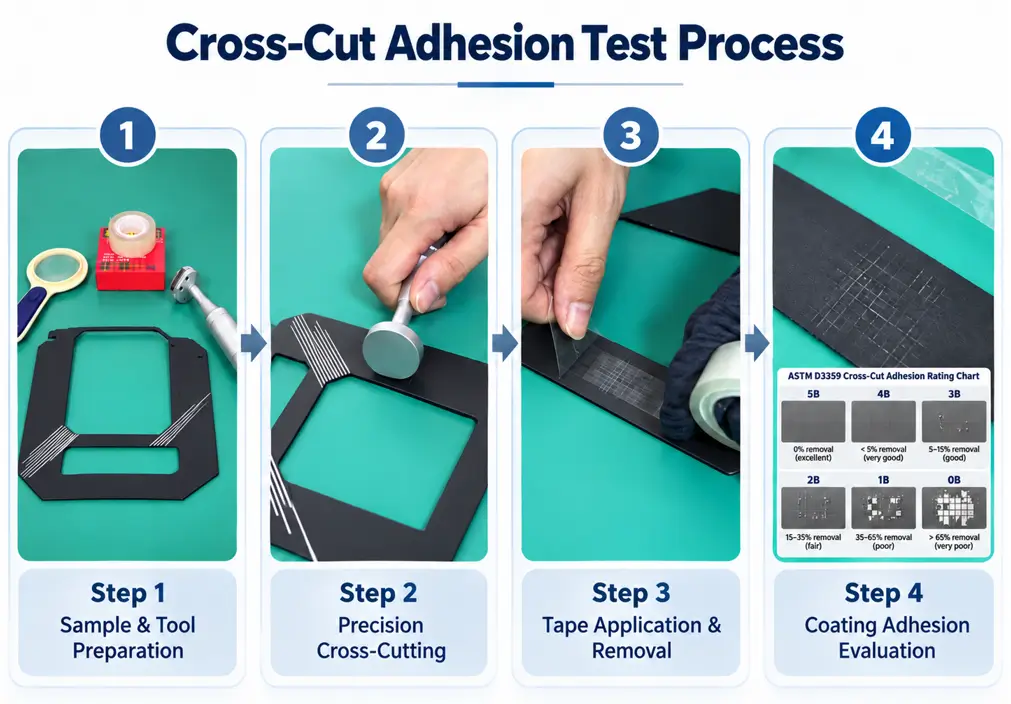
2. Testing Procedure — ASTM D3359 Method B
ASTM D3359 Method B evaluates coating adhesion by cutting a lattice pattern through the coating, applying adhesive tape, and examining coating removal after the tape is peeled away. The method is primarily intended for coatings with a total thickness below 125 μm.
| Step | Test Procedure |
|---|---|
| 1. Surface Inspection | Confirm the coating is properly cured and the test area is clean and free from visible defects. |
| 2. Cross-Cut Cutting | Use a suitable cutting tool to create evenly spaced perpendicular cuts through the coating to the substrate. |
| 3. Surface Cleaning | Remove loose coating particles and debris from the test area. |
| 4. Tape Application | Apply the specified adhesive tape over the lattice and press firmly to ensure uniform contact. |
| 5. Tape Removal | Remove the tape rapidly, without jerking, at an angle as close to 180° as possible. |
| 6. Result Evaluation | Inspect the lattice for coating detachment and assign a rating from 5B to 0B. |
[Video: Cross-Cut Adhesion Test — Innoway Precision]
The video demonstrates our actual testing procedure, including lattice cutting, tape application, removal, and final inspection.
3. Cross-Cut Adhesion Test Rating
Under ASTM D3359 Method B, coating adhesion is classified into six grades based on the extent of coating removal.
| Rating | Coating Removal | Classification |
|---|---|---|
| 5B | 0% | No peeling or detachment |
| 4B | Less than 5% | Minor flaking at intersections |
| 3B | 5–15% | Flaking along edges and intersections |
| 2B | 15–35% | Partial coating removal from lattice squares |
| 1B | 35–65% | Extensive peeling and square detachment |
| 0B | Worse than 1B | Severe coating failure |
ASTM D3359 Cross-Cut Adhesion Rating Chart
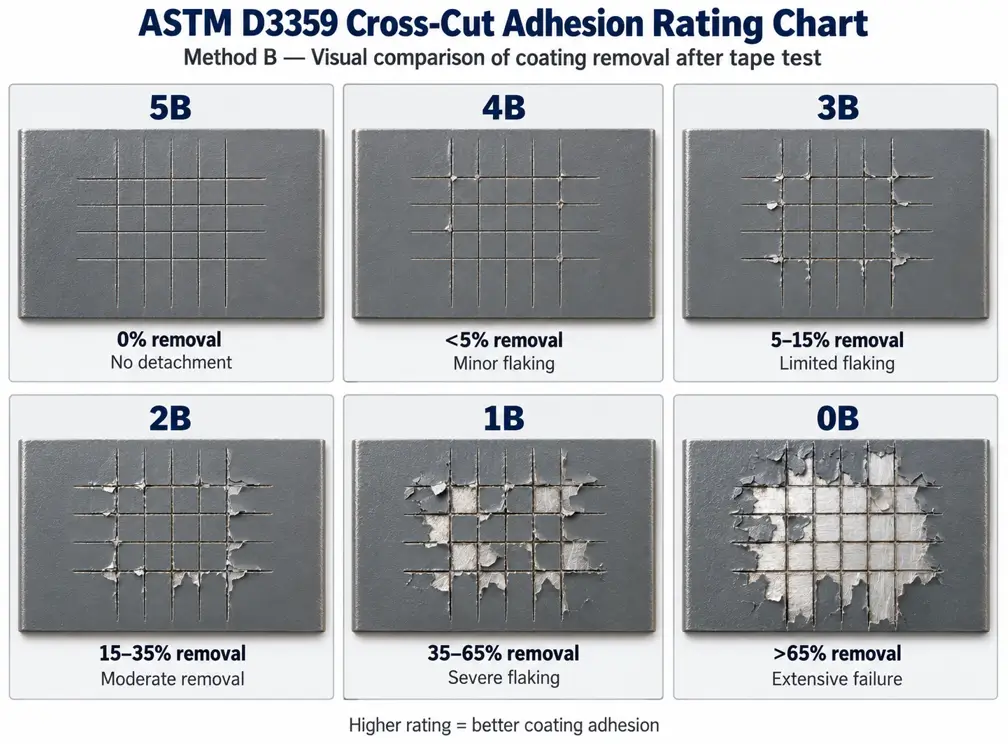
A 5B rating represents the best performance under this test method. However, the acceptance level must be defined by the customer’s technical specifications and the intended product application.
4. Critical Factors Affecting Test Results
Reliable cross-cut testing depends on consistent operating conditions.
Cutting Accuracy: The blade must be sharp, and each cut must penetrate the coating to the substrate. Incomplete cuts or excessive pressure can affect the evaluation.
Coating Thickness: The total coating thickness must be considered when selecting the cutting interval. Incorrect spacing may produce unreliable results.
Tape Application and Removal: Adhesive tape properties, contact pressure, peeling angle, and removal speed must be controlled to maintain test consistency.
Surface Preparation and Curing: Inadequate cleaning, surface contamination, or improper curing can contribute to poor coating adhesion. Abnormal results should trigger a review of the relevant manufacturing processes.
5. Coating Quality Control at Innoway Precision
At Innoway Precision, we understand that coating quality is more than a visual requirement.
For sheet metal and stamped components with specified coating adhesion requirements, we perform appropriate adhesion inspections as part of our quality control process.
When test results fail to meet the required criteria, our quality team works with production personnel to investigate potential causes, including surface pretreatment, coating thickness, and curing conditions.
By combining standardized testing with process control, we aim to minimize coating defects and maintain consistent product quality.
Frequently Asked Questions
The test evaluates how well a coating resists separation from a metal substrate or underlying coating layers after a lattice pattern is cut and adhesive tape is removed.
A 5B rating indicates that the edges of the cuts remain smooth and no coating squares detach during testing. It is the highest classification under ASTM D3359 Method B.
A 4B rating indicates minor flaking affecting less than 5% of the lattice area. Acceptance depends on customer specifications and application requirements.
No. The cross-cut test assesses coating adhesion performance under specified conditions. Corrosion resistance requires separate testing, such as salt spray testing.