1. What Is Laser Cutting?
Laser cutting is one of the most widely used processes in modern sheet metal fabrication. It provides fast cutting speeds, flexible geometry, narrow kerf widths, and excellent repeatability without requiring dedicated cutting tools.
Laser cutting is a non-contact manufacturing process that uses a highly concentrated laser beam to heat, melt, burn, or vaporize material along a programmed cutting path.
A typical laser cutting system includes:
- Laser source
- Optical or fiber delivery system
- Cutting head and focusing lens
- Assist gas system
- CNC motion system
- Cutting table
During cutting, the laser beam is focused onto a very small area of the workpiece. The material rapidly reaches its melting or vaporization temperature, while high-pressure assist gas removes molten material from the cutting kerf.
2. How Does Laser Cutting Work?
The laser cutting process can be simplified into four steps.
Step 1: Laser Generation
The laser source generates a high-energy beam. Depending on the machine type, the laser may be produced by a fiber laser source, CO₂ laser source, or another laser technology.
Step 2: Beam Focusing
The beam passes through the cutting head and is focused onto a very small spot on the material surface. This concentrated energy produces extremely high local temperatures.
Step 3: Material Melting
The focused laser heats the material until it melts, burns, or vaporizes. The cutting head follows the programmed CNC path.
Step 4: Molten Material Removal
Assist gases such as nitrogen, oxygen, or compressed air blow molten material away from the cutting zone. This produces a narrow and relatively clean cut. The combination of laser power, cutting speed, focus position, gas pressure, nozzle diameter, and material properties determines the final cutting quality.
3. Three Common Types of Laser Cutting
Three laser technologies are commonly discussed in industrial manufacturing.
| Laser Type | Typical Materials | Main Advantages | Typical Applications |
|---|---|---|---|
| Fiber Laser Cutting | Stainless steel, carbon steel, aluminum, copper, brass | High speed, high efficiency, excellent metal cutting capability | Sheet metal parts, brackets, enclosures, electrical components |
| CO₂ Laser Cutting | Metals, plastics, acrylic, wood and non-metallic materials | Good versatility and smooth cutting on many materials | Signage, acrylic products, non-metal fabrication |
| Nd / Solid-State Laser | Metals and precision applications | High energy concentration and fine processing capability | Precision components, drilling, specialty laser processing |
4. What Materials Can Be Laser Cut?
Laser cutting can process a wide range of engineering materials, but cutting behavior varies significantly depending on thermal conductivity, reflectivity, thickness, and surface condition. Common materials include:
Stainless Steel
Stainless steel can be cut cleanly using nitrogen-assisted fiber laser cutting. Nitrogen prevents oxidation of the cutting edge, producing a cleaner metallic surface suitable for subsequent welding, polishing, or cosmetic applications.
Common grades include: SUS304, SUS316, SUS430.
Carbon Steel
Carbon steel is one of the easiest materials to laser cut. Oxygen is frequently used as the assist gas because the oxidation reaction increases cutting efficiency. Typical materials include: SPCC, Q235, SGCC, SECC, Mild steel
Aluminum
Aluminum has relatively high thermal conductivity and reflectivity, making it more challenging than carbon steel. Modern high-power fiber lasers, however, can cut aluminum efficiently. Typical grades include: AL5052, AL6061, AL1050, AL3003, AL7075.
Copper and Brass
Copper and brass are highly reflective materials. Older laser systems sometimes struggled with these materials, but modern fiber lasers can cut thin and medium-thickness copper alloys effectively. Proper machine configuration and laser parameters remain important.
5. Laser Cutting Accuracy and Tolerance
Laser cutting is highly accurate for general sheet metal fabrication, but it should not automatically be treated as a machining-level precision process.
Actual tolerance depends on:
- Material type
- Material thickness
- Part dimensions
- Laser power
- Machine condition
- Cutting parameters
- Thermal distortion
- Feature size
For many sheet metal parts, achievable dimensional tolerances are typically around: ±0.10 mm to ±0.20 mm. under appropriate production conditions. Higher accuracy may be possible for certain materials, thicknesses, and geometries, but tolerance requirements should always be reviewed based on the actual part design.
Small Holes Require Special Attention
One common design mistake is specifying extremely small holes in thick sheet material. As the hole diameter approaches the material thickness, cutting quality may decrease because of:
- Heat accumulation
- Poor molten material evacuation
- Increased taper
- Dross formation
- Hole deformation
For critical small holes, machining or drilling may provide better results.
6. Laser Cutting Kerf
The laser does not cut along a mathematically zero-width line. Instead, it removes a narrow strip of material called the kerf. Kerf width depends on:
- Laser type
- Material
- Material thickness
- Focus position
- Cutting speed
- Laser power
The CNC system compensates for kerf automatically when generating the cutting path.
Kerf control is important when producing:
- Slots
- Tabs
- Interlocking structures
- Tight-fit assemblies
- Precision holes
Without proper compensation, mating parts may become too loose or too tight.
7. Common Laser Cutting Quality Problems
Even modern laser cutting machines can produce defects if the process parameters are not properly controlled.
| Cutting Problem | Common Cause | Possible Improvement |
| Dross on cutting edge | Incorrect speed or gas pressure | Optimize speed and assist gas |
| Excessive burning | Laser power too high or speed too low | Adjust cutting parameters |
| Rough cutting surface | Incorrect focus or unstable beam | Check focus and optical system |
| Hole deformation | Hole too small relative to thickness | Increase hole diameter or use secondary machining |
| Edge oxidation | Oxygen cutting or insufficient nitrogen | Use nitrogen for oxidation-free edges |
| Thermal distortion | Excessive heat accumulation | Optimize cutting sequence |
For production parts, controlling cutting parameters is only part of the process.
Material flatness, nesting strategy, cutting sequence, machine maintenance, and operator experience also affect final part quality.
8. Advantages of Laser Cutting
Laser cutting offers several important advantages for sheet metal manufacturing.
High Cutting Speed
For thin and medium sheet metal, fiber laser cutting can achieve very high production speeds.
No Dedicated Cutting Tool
Unlike stamping, laser cutting does not require a dedicated punch or die.
This significantly reduces tooling costs for prototypes and low-volume orders.
High Design Flexibility
Different geometries can be produced simply by changing the CNC program.
This makes laser cutting ideal for:
- Prototyping
- Engineering changes
- Small batches
- Customized components
Narrow Kerf
The small cutting width allows efficient nesting and better material utilization.
Easy Integration With Sheet Metal Fabrication
Laser-cut blanks can directly enter subsequent processes such as:
Laser Cutting → Bending → Welding → Riveting → Surface Treatment → Assembly
This makes laser cutting an important foundation of modern sheet metal production.
9. Limitations of Laser Cutting
Laser cutting also has limitations.
Heat-Affected Zone
Because laser cutting is a thermal process, a small heat-affected zone may develop along the cutting edge. For many sheet metal applications this is acceptable, but it may matter for certain precision, metallurgical, or heat-sensitive components.
Cutting Capacity Depends on Thickness
As material thickness increases, cutting speed decreases and edge quality becomes more difficult to maintain.
Not Ideal for Every Ultra-Precision Feature
Laser cutting cannot completely replace: Wire EDM, CNC machining, Grinding, Precision drilling. when extremely tight tolerances or very small precision features are required.
Reflective Materials Require Proper Equipment
Copper, brass, and some aluminum alloys require appropriate laser sources and cutting parameters.
10. Laser Cutting vs. EDM Cutting
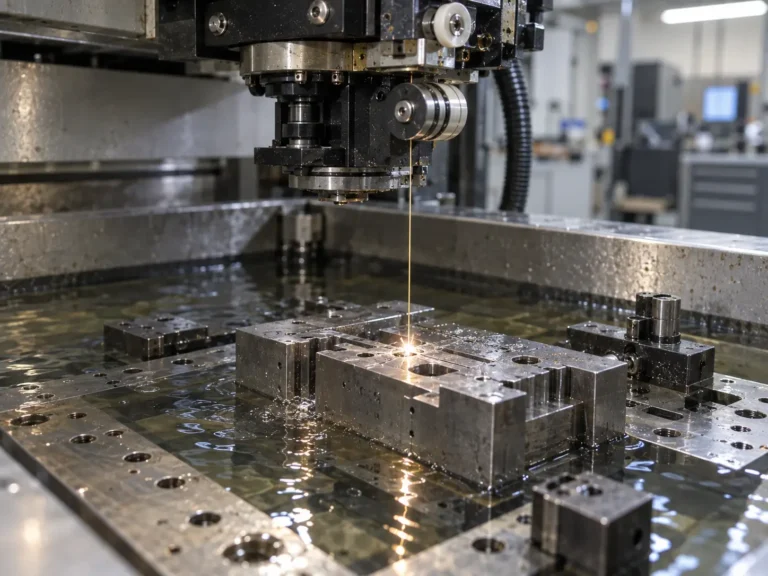
Laser cutting and Wire EDM are both precision cutting technologies, but their working principles and ideal applications are very different.
| Comparison | Laser Cutting | Wire EDM Cutting |
| Cutting Principle | Concentrated laser energy melts or vaporizes material | Electrical discharge removes material |
| Tool Contact | No physical contact | No physical contact |
| Cutting Speed | Very fast for sheet metal | Relatively slow |
| Material Requirement | Many metals and non-metals depending on laser type | Electrically conductive materials only |
| Typical Thickness | Excellent for thin and medium sheet metal | Excellent for thick precision conductive parts |
| Heat-Affected Zone | Small HAZ exists | Very small thermal influence |
| Precision | High | Extremely high |
| Complex Internal Profiles | Good | Excellent |
| Tooling Cost | No dedicated cutting die required | No dedicated cutting die required |
| Typical Applications | Sheet metal fabrication, enclosures, brackets | Dies, molds, precision inserts, complex profiles |
The key difference is simple: Laser cutting prioritizes speed and manufacturing flexibility, while Wire EDM prioritizes extreme precision and complex profiles.
For example, a sheet metal enclosure may be laser cut within seconds, while the same geometry would be inefficient to produce using Wire EDM.
However, a hardened steel die insert requiring very tight dimensional accuracy and sharp internal geometry may be much better suited for EDM.
Therefore, these technologies are not direct replacements for each other. They solve different manufacturing problems.
11. Laser Cutting vs. Stamping
Laser cutting and stamping are also frequently compared during product development.
Laser cutting is usually preferred when:
- Production volume is relatively low
- Designs are still changing
- Tooling investment must be minimized
- Multiple product versions are required
Stamping becomes more economical when:
- Production volume is high
- Geometry is stable
- Very short cycle time is required
- Progressive dies can combine multiple forming operations
A common manufacturing strategy is: Prototype with laser cutting → verify the design → develop stamping tooling for mass production. This approach reduces tooling risk during early product development.
12. DFM Tips for Laser-Cut Parts
Good laser cutting design can reduce manufacturing cost and improve consistency.
* Avoid Extremely Small Holes
Do not specify unnecessarily small holes, especially in thick sheets.
* Maintain Suitable Feature Spacing
Small gaps between holes, slots, and external edges may cause excessive local heating or deformation.
* Consider the Bending Process
For sheet metal parts, laser cutting should not be designed independently from subsequent bending. Hole position, bend radius, bend relief, and bend allowance should be reviewed together.
* Avoid Unnecessary Tight Tolerances
A dimension of ±0.05 mm may significantly increase manufacturing difficulty if the function only requires ±0.20 mm. Functional tolerancing usually provides better manufacturing economics.
* Discuss Critical Features Early
If certain holes or surfaces require machining-level accuracy, they can be intentionally left for secondary CNC machining after laser cutting. This often produces a more reliable and cost-effective manufacturing process.
Conclusion
Laser cutting combines speed, flexibility, automation, and good dimensional accuracy, making it one of the most important processes in modern sheet metal fabrication.
Fiber laser technology has further expanded its capabilities, allowing manufacturers to efficiently process stainless steel, carbon steel, aluminum, copper, brass, and other engineering metals.
However, selecting the right cutting process should always depend on the actual part requirements.
For fast and flexible sheet metal production, laser cutting is usually the preferred solution.
For extremely tight tolerances, hardened conductive materials, and complex precision profiles, Wire EDM may provide better results.
Understanding the strengths of both technologies allows engineers to choose the most economical and technically appropriate manufacturing process.
FAQ
Laser cutting is a non-contact manufacturing process that uses a focused laser beam to melt, burn, or vaporize material along a programmed cutting path. It is widely used for sheet metal parts, brackets, enclosures, frames, and structural components.
Common laser-cut materials include stainless steel, carbon steel, aluminum, galvanized steel, copper, and brass. Modern fiber laser systems are especially effective for cutting metallic materials.
For general sheet metal fabrication, laser cutting can typically achieve tolerances of around ±0.10 mm to ±0.20 mm, depending on material thickness, part geometry, machine condition, and cutting parameters.
Fiber lasers are generally faster and more energy-efficient for cutting metals such as stainless steel, carbon steel, aluminum, copper, and brass. CO₂ lasers offer broader compatibility with some non-metal materials such as acrylic and wood.
It depends on the application. Laser cutting is faster and more economical for sheet metal fabrication, while Wire EDM is better for extremely tight tolerances, hardened conductive materials, and complex precision profiles.
Yes. Laser cutting is suitable for prototypes, low-volume orders, and medium-volume production. For very high-volume stable parts, stamping may become more economical because of its shorter cycle time.