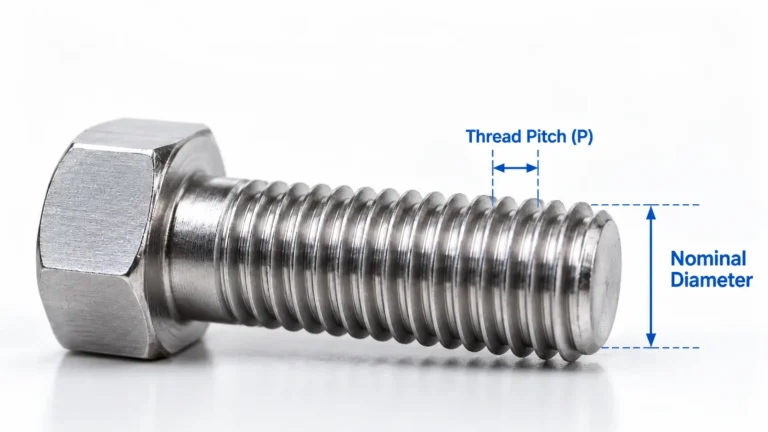
1. Why Screw Head Design Matters
Screw head design affects more than the appearance of an assembly. It determines the required installation tool, available tightening torque, bearing area, head protrusion, assembly clearance and ease of future maintenance. Two screws with the same thread diameter, length and material may perform very differently when their head designs are different.
For this reason, specifying only a size such as “M4 × 10” is not sufficient. A complete fastener specification should also include the head type, drive type, thread pitch, material, property class, surface finish and any thread-locking requirement.
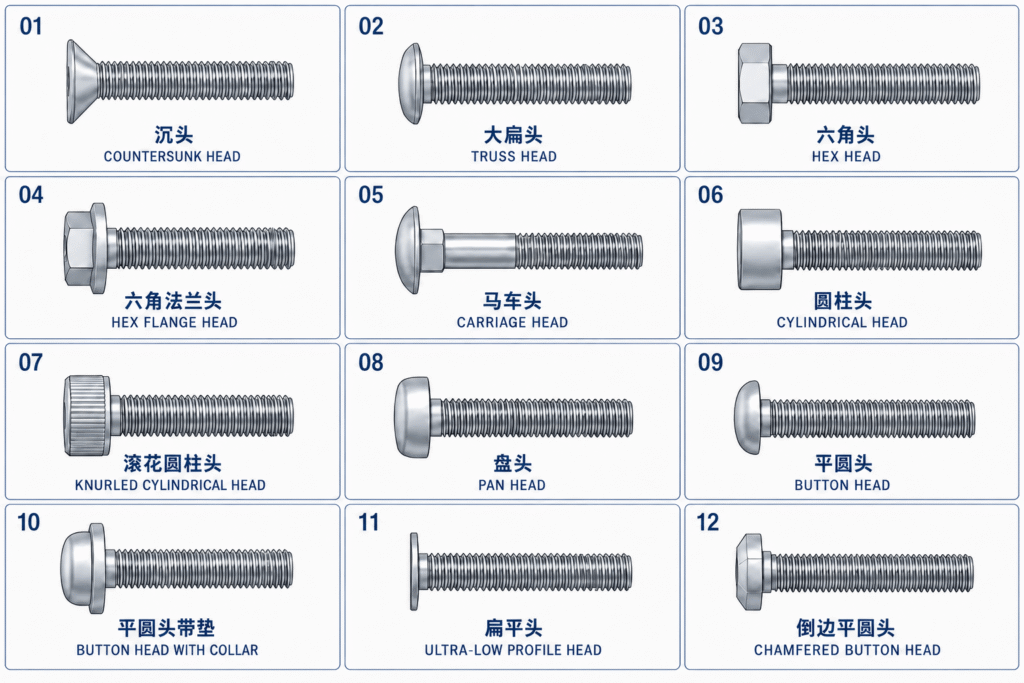
2. Features and Applications of 12 Screw Head Types
| No. | Screw Head Type | Main Features | Typical Applications |
|---|---|---|---|
| 01 | Countersunk Head | A conical head designed to sit flush with the surrounding surface. It requires a countersunk mounting hole with a matching angle and diameter. | Covers, hinges, guide rails, enclosures and surfaces where protruding screw heads are not permitted |
| 02 | Truss Head | An extra-wide, low-profile head with a smooth curved transition around the edge. The large bearing surface helps distribute clamping force. | Thin sheet metal, plastic parts, household appliances and electronic enclosures |
| 03 | Hex Head | An external hexagonal head that can be tightened with a wrench or socket. It supports relatively high installation torque but requires radial tool clearance. | Machinery, frames, automotive components and structural assemblies |
| 04 | Hex Flange Head | A hex head with an integrated flange under the head. The flange increases the bearing area and may eliminate a separate washer in some applications. | Automotive brackets, equipment frames, cabinets and assemblies exposed to vibration |
| 05 | Carriage Head | A smooth rounded head with a square neck underneath. The square neck engages a square hole and prevents the bolt from rotating while the nut is tightened. | Guards, frames, furniture, timber structures and assemblies accessible from only one side |
| 06 | Cylindrical Head | A tall cylindrical head with a relatively small outside diameter. When combined with an internal hex drive, it can transmit high tightening torque in limited radial space. | Moulds, fixtures, automation equipment and compact mechanical assemblies |
| 07 | Knurled Cylindrical Head | The side of the cylindrical head has a knurled surface for improved grip. Some versions are designed for manual adjustment, while others also include an internal drive. | Adjustment mechanisms, inspection covers, fixtures and frequently serviced assemblies |
| 08 | Pan Head | A general-purpose head with a slightly domed top and a flat bearing surface underneath. It provides a good balance between head height, bearing area and installation convenience. | Electronics, electrical equipment, sheet metal enclosures and internal brackets |
| 09 | Button Head | A low, smooth and continuously curved head that reduces snagging and provides a clean appearance. Its drive depth and head strength are generally lower than those of a standard socket head cap screw. | Equipment covers, furniture, consumer products and visible exterior surfaces |
| 10 | Button Head with Collar | A button head with an integrated collar or flange. The enlarged bearing surface spreads the clamping load over a wider area. | Thin sheet metal, plastic housings, appliances and electronic products |
| 11 | Ultra-Low Profile Head | An extremely thin and wide head designed to minimise protrusion. Because the drive recess is shallow, it is generally unsuitable for very high installation torque. | Display brackets, sliding mechanisms, precision equipment and ultra-thin assemblies |
| 12 | Chamfered Button Head | A low round head with a clearly defined straight chamfer around its outer edge. Unlike the continuous curved transition of a truss head, the chamfer is an intentional geometric feature. | Consumer electronics, decorative panels, furniture hardware and customised mechanical assemblies |
The names used for cylindrical, knurled, ultra-low-profile and chamfered heads are not always consistent among suppliers. A name such as “low-profile head” or “chamfered button head” should therefore not be used as the only purchasing requirement. A standard number or a fully dimensioned head drawing should also be provided.
3. Screw Head Selection and Specification Guide
For surfaces that must remain flush, a countersunk screw is normally the preferred choice. The countersink angle, diameter and depth must match the screw head. In thin sheet metal, the remaining material thickness must also be checked to prevent distortion, pull-through or loss of bearing strength. ISO 10642:2026 defines hexagon socket countersunk head screws as fasteners with reduced loadability due to their head design.
For thin sheet metal, plastic or other materials that may be damaged by concentrated clamping force, truss heads, flange heads and heads with integrated collars are generally more suitable. Their larger bearing surfaces distribute the load, although a separate washer or metal insert may still be required when the base material is very soft.
Hex heads, hex flange heads and cylindrical socket heads are suitable when higher tightening torque or preload is required. Common references include ISO 4017:2022 for hexagon head screws, ISO 4162:2012 for hexagon flange bolts and ISO 4762:2004 for hexagon socket head cap screws. The product design must provide adequate space for the wrench, socket or driver bit.
Button heads, ultra-low-profile heads and chamfered button heads are useful when protrusion and appearance are more important than maximum tightening capacity. They should not automatically replace standard hex or cylindrical heads in highly preloaded joints. Hexagon socket button head screws and button head screws with collars are covered by ISO 7380-1:2022 and ISO 7380-2:2022, respectively, and both have reduced head loadability.
A complete purchasing specification should include:
- Applicable standard or a fully dimensioned drawing
- Thread diameter, pitch and nominal length
- Head type and drive system
- Fully threaded or partially threaded design
- Material, such as carbon steel, alloy steel or A2/A4 stainless steel
- Property class, such as 8.8, 10.9 or 12.9
- Surface finish, such as zinc plating, zinc-nickel plating, black oxide or zinc-flake coating
- Required installation torque
- Corrosion resistance and operating temperature
- Pre-applied thread-locking, nylon locking or sealing requirements
A typical specification could be written as:
ISO 7380-1, M5 × 0.8 × 12, property class 10.9, hexagon socket, zinc-nickel plated, with pre-applied thread-locking patch.
FAQ
A countersunk head sits flush inside a matching countersunk hole, while a pan head uses a flat bearing surface and remains above the assembled surface.
Not always. A separate washer or sealing element may still be required for soft materials, slotted holes, sealing joints or applications where the friction condition must be controlled.
Button heads are suitable for low-clearance and appearance-sensitive applications, but their head and drive capacity are generally lower than those of standard hex or socket head fasteners.
The square neck under the round head engages a square hole or deforms slightly into a softer material, preventing the bolt from rotating.
Most protruding-head screws are measured from underneath the head. Countersunk screws are normally measured over their complete length, including the head, although the applicable standard should always be checked.
No. It may also be a nylon locking patch, sealing compound or identification coating. The supplier’s technical specification must be used to confirm its function.