
1. What Is a Shipping Mark?
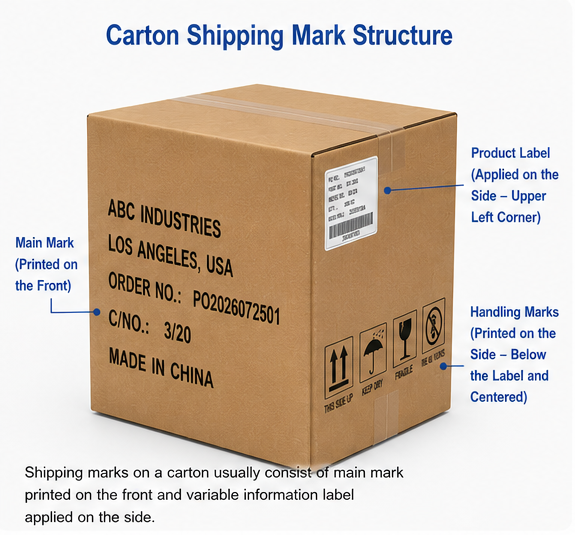
In international trade and logistics, Shipping Mark generally refers to the identification information displayed on cartons, wooden cases, or other forms of outer packaging.
Shipping marks allow consignees, warehouse staff, carriers, and customs personnel to identify the goods without opening the package. They help determine which order the carton belongs to, what is packed inside, and whether any special handling precautions are required.
In practice, carton shipping marks usually consist of two parts:
| Type | Common Form | Typical Information |
|---|---|---|
| Fixed packaging marks | Printed directly on the carton | Handling symbols, orientation marks, carton specifications, and other fixed information |
| Variable product labels | Printed separately and applied to the carton | Order number, product name, part number, model, quantity, batch number, and other changing information |
2. Main Functions of Shipping Marks
2.1 Cargo Identification
A shipment may contain products for different customers, orders, models, or production batches. Shipping marks act as the package’s identification information, helping warehouse and logistics personnel distinguish cartons and reduce mix-ups, incorrect shipments, and missing packages.
2.2 Packing Information
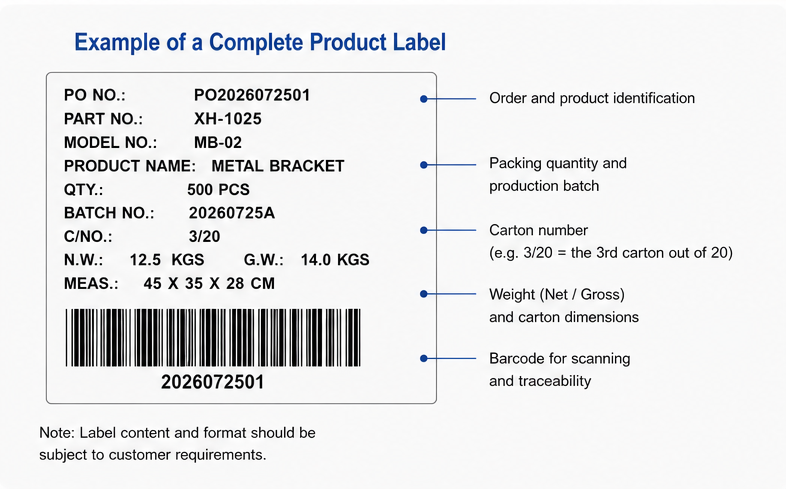
A carton label allows users to check the product name, part number, quantity, production batch, and carton number without opening the package.
2.3 Handling and Storage Instructions
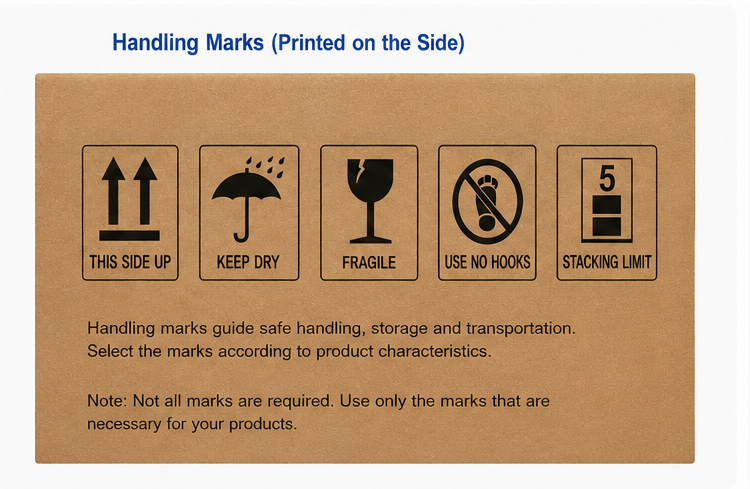
Symbols such as This Side Up, Keep Dry, and Fragile remind handlers how the package should be stored and transported. These marks help reduce the risk of moisture, inversion, impact, or excessive pressure during transit.
2.4 Order and Batch Traceability
Order numbers, batch numbers, barcodes, and QR codes can connect the carton to purchase orders, packing lists, inspection records, and production records. This supports warehouse receiving and quality traceability.
3. What Information Is Usually Printed Directly on the Carton?
Information printed directly on the carton is usually fixed and does not change frequently between orders.
3.1 Common Handling Marks
| Packaging Mark | Common English Text | Meaning |
|---|---|---|
| Upward arrows | This Side Up | Keep the carton in the correct orientation |
| Umbrella symbol | Keep Dry | Protect the carton from rain and moisture |
| Broken glass symbol | Fragile | Handle carefully and avoid impact |
| No stepping symbol | Do Not Step | Do not stand or step on the carton |
| Hook prohibition symbol | Use No Hooks | Do not use metal hooks for handling |
| Stacking limit symbol | Stacking Limit | Indicates the maximum stacking height or number of layers |
Other information that may be printed directly on the carton includes:
- Carton size or carton model
- Carton manufacturer information
- Company name or logo
- Recycling symbols
- Customer-specified fixed packaging symbols
- Country-of-origin marking
It is important to note that Made in China is not automatically required on every carton. Whether it should be shown depends on customer requirements, export documents, product regulations, and destination-country requirements.
3.2 Weight and Carton Dimensions
Gross weight, net weight, and carton dimensions may either be printed directly on the carton or included on the applied label, depending on the packaging method.
| Information | Common Abbreviation | Meaning |
|---|---|---|
| Gross weight | G.W. | Total weight of the product and all packaging materials |
| Net weight | N.W. | Weight of the products inside the carton |
| Carton dimensions | MEAS. | External length, width, and height of the carton |
For products with a fixed carton size and consistent quantity per carton, the carton may have pre-printed fields where the weight is added later by printing, stamping, or handwriting.
For low-volume, high-mix, or customized orders where the weight differs from carton to carton, it is usually better to include the information on the printed label.
Example:
N.W.: 12.5 KGS
G.W.: 14.0 KGS
MEAS.: 45 × 35 × 28 CM
The weight and dimensions should be based on the actual packed carton rather than an unverified estimate.
4. What Information Is Usually Printed on a Label and Applied to the Carton?
Information that changes according to the order, product, or production batch is usually printed on a white label with black text and then applied to a specified position on the carton.
Common Label Information
| Label Item | Common English Term |
|---|---|
| Customer code | Customer Code |
| Purchase order number | PO No. / Order No. |
| Product name | Product Name |
| Product part number | Part No. |
| Product model | Model No. |
| Product specification | Specification |
| Packing quantity | QTY / Quantity |
| Production batch | Batch No. / Lot No. |
| Production date | Production Date |
| Carton number | Carton No. / C/NO. |
| Barcode or QR code | Barcode / QR Code |
These items change frequently. Using a standard carton together with a variable printed label reduces the number of carton types required, lowers packaging inventory, and makes corrections or reprinting easier.
5. Where Should a Carton Label Be Applied?
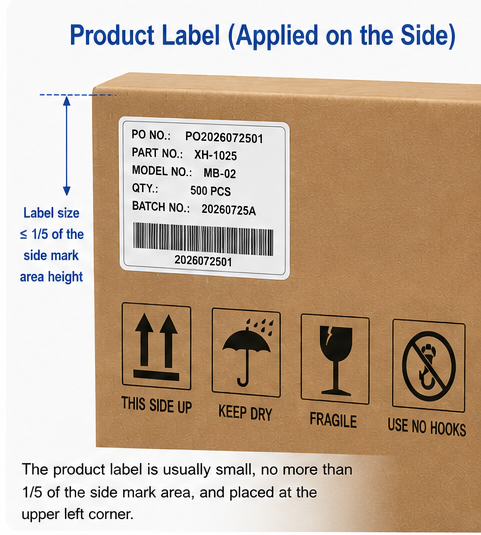
The label should be placed on a flat, visible area that is easy to read and scan. The position should remain consistent across the same shipment.
Recommended positions include: 1. Upper-right area of the carton front; 2. Center of the carton side; 3. Customer-specified label area; 4. A visible outer side of a palletized load.
Avoid placing the label over: 1. Sealing tape; 2. Strapping bands; 3. Carton fold lines; 4. Carton joints; 5. Corners exposed to abrasion; 6. Uneven or damaged surfaces.
When the carton is wrapped with transparent stretch film, the label should remain visible and scannable after wrapping.
6. Important Points When Designing and Using Shipping Marks
6.1 Separate Fixed and Variable Information
Handling symbols and general packaging information may be printed directly on the carton. Variable information such as order number, part number, quantity, and batch number should normally be printed on a separate label.
6.2 Keep All Information Consistent
The label must match the purchase order, packing list, inspection record, and actual products inside the carton. Part number, quantity, and carton number require particular attention.
6.3 Remove Old Labels
When cartons are reused, all previous order labels, barcodes, and shipping information must be completely removed or fully covered to prevent identification errors.
6.4 Keep Labels Clear and Secure
Labels should not be wrinkled, damaged, contaminated, poorly printed, or lifting at the edges. Barcodes and QR codes should be tested with an actual scanner.
6.5 Protect Confidential Customer Information
Customer names, logos, product applications, and project names may be confidential. They should not be displayed on the outer packaging without customer approval.
FAQ
Not exactly. A shipping mark is the general term for identification information shown on outer packaging. It may include symbols printed directly on the carton as well as product labels applied later.
Fixed handling symbols such as This Side Up, Keep Dry, Fragile, Do Not Step, and Use No Hooks are generally suitable for direct carton printing. Standard carton information may also be printed.
Variable information such as the order number, product name, part number, model number, packing quantity, and production batch is normally printed on a white label with black text and then applied to the carton.
C/NO. is an abbreviation for Carton Number. It identifies the current carton within a shipment.
For example, C/NO. 3/20 means that the carton is number 3 out of a total of 20 cartons.
No. When the customer has no specific requirement, the main mark and side mark information may be combined into one label.
No. Country-of-origin marking should be determined according to customer requirements, product export requirements, and the regulations of the destination country.
Not always. A barcode or QR code is usually required when the customer uses scanning for receiving, inventory management, or quality traceability.
Multiple labels may be used, but each label should have a clear purpose. The information must not be duplicated unnecessarily, conflict with other labels, or block a barcode.