1. The Purpose of Grinding: Removing Burrs
Grinding deburring is a key finishing process for stamped and machined metal parts. It removes sharp burrs, improves assembly safety and prepares metal edges for coating and assembly.
Stamping, drilling, milling and turning all create burrs where the material is separated. On stamped parts, burrs are usually concentrated on the die-exit side, around punched holes and along blanked profiles. On machined parts, they are commonly found on milled edges, drill exits, intersecting holes and thread entries.
Although these burrs may be small, they can cause assembly interference, damage cables or injure operators. They may also affect part fit, sealing, electroplating and coating quality.
In this article, “grinding” mainly refers to batch or localized finishing processes that use abrasives, grinding media or abrasive tools to treat part edges. It does not refer to precision surface grinding performed primarily to achieve highly accurate dimensions.
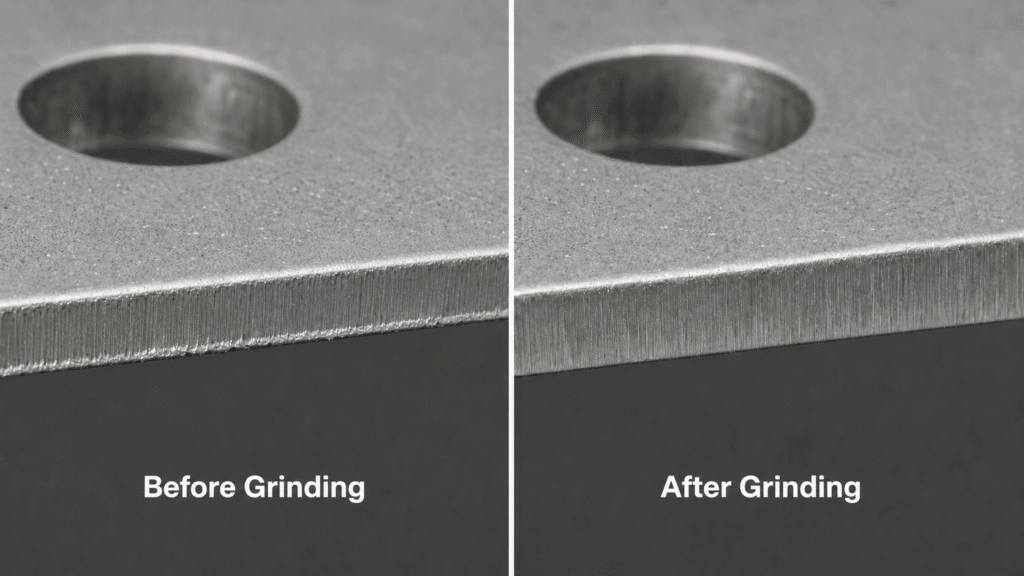
A controlled grinding process removes the sharp burr without excessively rounding the edge or changing the part geometry.
2. How Grinding Removes Burrs
In vibratory finishing, the parts, grinding media, water and finishing compound continuously circulate inside the machine. The relative movement between the media and the part surface gradually removes small burrs and creates a slight, consistent radius along exposed edges.
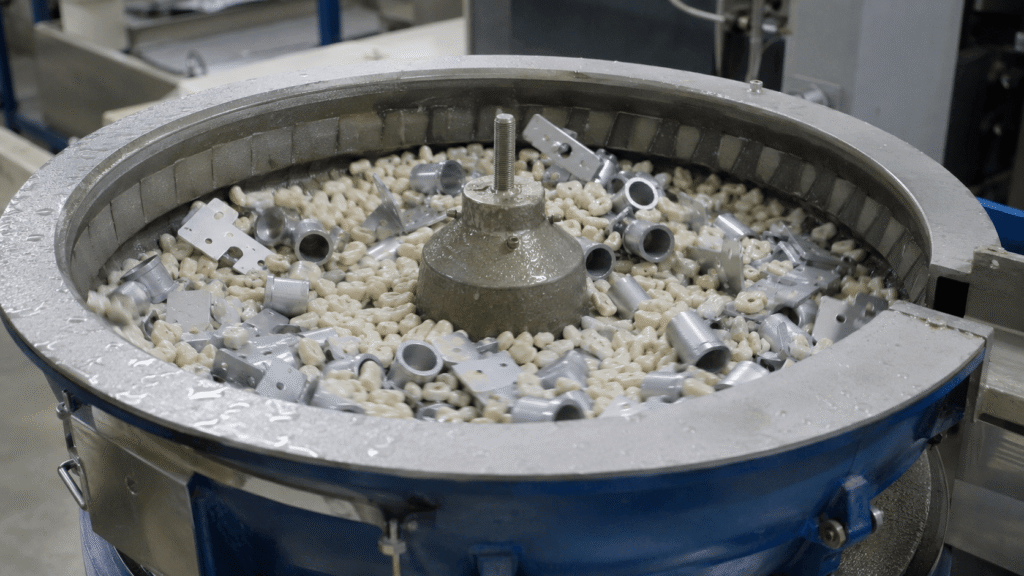
Grinding media repeatedly contacts the exposed edges of stamped and machined parts during vibratory finishing.
The final result does not depend on processing time alone. The material, shape and size of the grinding media determine its cutting ability and whether it can reach holes, slots and corners. Machine amplitude, load ratio, compound concentration and cycle time also influence burr-removal speed and surface quality.
Ceramic media normally provides stronger cutting action and is suitable for steel parts or more noticeable burrs. Plastic or resin-bonded media is gentler and is often more suitable for aluminum, copper alloys and parts with higher surface requirements.
A typical process sequence is:
Degreasing → Rough Deburring → Fine Finishing if Required → Cleaning → Drying or Rust Protection
Parts with large rollover burrs, heavy remnants or localized tool marks should first be treated with an abrasive belt, brush or another suitable pre-deburring method before batch finishing.
3. Selecting a Grinding Method for Stamped and Machined Parts
| Grinding method | Typical applications | Main characteristics and precautions |
|---|---|---|
| Vibratory or barrel finishing | Small and medium stamped parts, turned parts and milled components | Suitable for batch removal of small burrs with good consistency; thin parts must be protected from deformation, nesting and part-to-part damage |
| Magnetic finishing | Small precision components, fine grooves and some intersecting-hole structures | Effective for micro-burrs and complex locations, but the material, geometry and critical dimensions must be verified through sample trials |
| Abrasive belt or brush grinding | Larger sheet-metal parts, blanked edges, laser-cut edges and stronger localized burrs | Provides fast material removal; excessive pressure may cause edge collapse, scratches or localized dimensional changes |
| Manual or pneumatic tools | Samples, low-volume parts and locations that machines or media cannot reach | Flexible, but consistency depends on operator technique; fixtures and standardized work instructions should be used |
Thin stamped parts require particular attention to part-to-part collision, warping and nesting. Machined parts require additional protection for threads, sealing surfaces, precision bores and functional sharp-edge areas.
Ordinary grinding media may not effectively reach deep blind holes, narrow slots or hidden intersecting holes. Burr removal in these locations cannot be confirmed by external appearance alone.
4. Quality Control: Deburring Must Protect Dimensions and Function
Grinding quality should not be judged only by whether a part feels smooth. The drawing or inspection standard should define the permitted edge condition, such as “free from loose burrs,” “break all sharp edges,” or a specified chamfer or radius, while also identifying areas where grinding is prohibited. Inspection should cover residual or detachable burrs, edge condition, critical dimensions, flatness, deformation, surface damage, cleanliness, residual compound and corrosion risk.
Insufficient grinding leaves burrs behind, while excessive processing may enlarge hole entrances, blunt thin edges, change dimensions or remove the original surface texture. Sealing surfaces, electrical contact areas, press-fit edges and cosmetic surfaces should therefore be protected or processed separately. The media, load ratio and cycle time should be confirmed through sample trials, with an approved part or limit sample retained as the production reference to ensure safe, clean and assembly-ready components.
For support with stamped parts, sheet-metal components, CNC machined parts and production deburring, please contact us.
FAQ
No. Vibratory grinding is best suited to small burrs on edges that the grinding media can reach. Large rollover burrs, thick remnants and burrs inside inaccessible features may require belt grinding, abrasive brushing, machining or a dedicated deburring tool before mass finishing.
It can. If the media is too aggressive or the cycle is too long, grinding may enlarge hole entrances, round thin edges or affect precision features. Critical dimensions should therefore be checked during sample validation and regular production inspection.
Deburring is normally completed before electroplating, painting, anodizing or powder coating. Removing burrs first provides a cleaner and more consistent edge for the coating. Grinding after surface treatment should be used only when specifically required because it may damage the finished layer.
Media selection depends on the part material, burr size, geometry and required surface quality. Ceramic media normally provides faster cutting, while plastic or resin-bonded media is gentler on aluminum, copper alloys and sensitive surfaces. Its size and shape must also prevent the media from becoming lodged in holes or slots.
There is no universal cycle time. The process should be established through sample trials with inspections at controlled intervals. The final setting should use the shortest cycle that consistently meets the burr, edge, dimensional and surface requirements.
📧 sales@innoway-metalparts.com
🌐 www.innoway-metalparts.com
📞 +86 18824570656