1. What Is the Nominal Diameter of a Screw?
The nominal diameter is the standard diameter used to identify the size of a metric thread. For example:
- M3 → Nominal diameter: 3 mm
- M4 → Nominal diameter: 4 mm
- M6 → Nominal diameter: 6 mm
- M8 → Nominal diameter: 8 mm
Therefore, the “6” in M6 means that the thread has a nominal diameter of 6 mm.
For a standard external metric thread, the nominal diameter can generally be understood as the basic major diameter, measured across the thread crests.
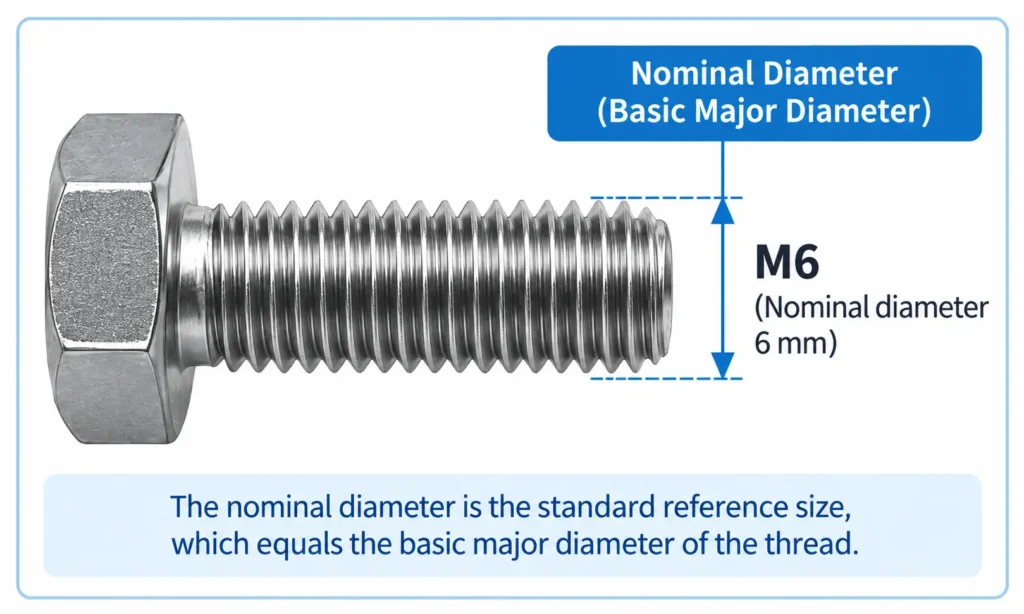
It is important to note that the nominal diameter is a standard reference size. Due to thread tolerances, the actual outside diameter measured with a caliper may be slightly smaller than the nominal value.
2. What Is Thread Pitch?
Thread pitch is the axial distance between corresponding points on two adjacent threads, usually measured from one thread crest to the next. For example:
M6 × 1.0, means:
- M = Metric thread
- 6 = Nominal diameter of 6 mm
- 1.0 = Thread pitch of 1.0 mm
In other words, the distance between two adjacent thread crests is 1.0 mm.
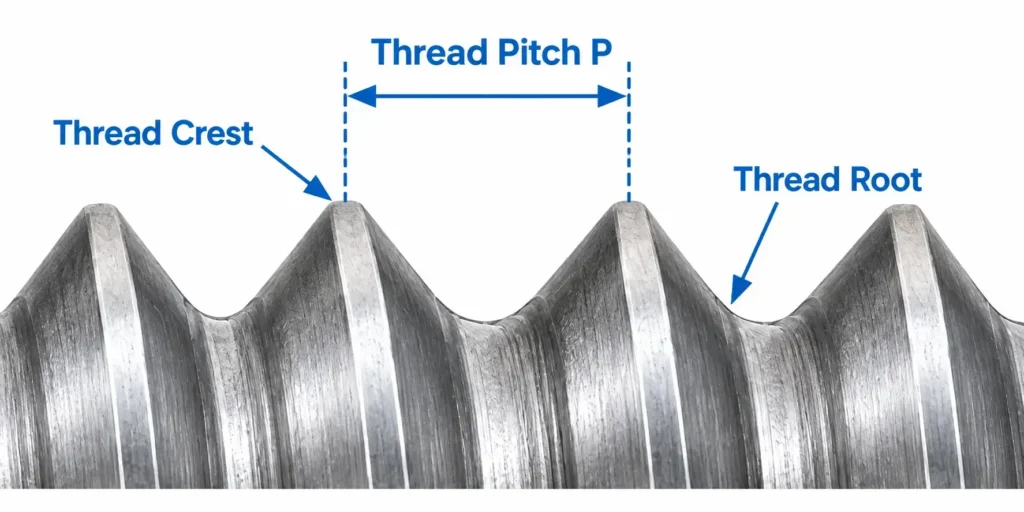
A larger pitch generally means a coarser thread, while a smaller pitch means a finer thread.
3. How to Read M6 × 1.0
A simple way to understand the specification is:
M6 × 1.0 = 6 mm nominal diameter + 1.0 mm thread pitch
The nominal diameter tells you the size of the thread, while the pitch tells you how closely the threads are spaced. Therefore, when identifying or selecting a screw, both parameters should be checked.
In Simple Terms
Nominal diameter tells you how large the thread is. Thread pitch tells you how closely the threads are spaced. Together, these two dimensions define the basic size of a metric thread.
Frequently Asked Questions
The nominal diameter is the standard diameter used to identify the size of a thread. For metric threads, it generally corresponds to the basic major diameter of the external thread.
Thread pitch is the axial distance between corresponding points on two adjacent threads, usually measured from one thread crest to the next.
In a specification such as M8 × 1.25, “M” indicates a metric thread, “8” is the nominal diameter in millimeters, and “1.25” is the thread pitch in millimeters.
Not always. Nominal diameter is a standard reference size, while the actual outside diameter may be slightly smaller because of manufacturing tolerances.
Coarse threads have a larger pitch and fewer threads over the same length, while fine threads have a smaller pitch and more closely spaced threads.
Yes. Screws can have the same nominal diameter but different thread pitches. For example, two metric threads may both have the same diameter but use coarse or fine pitches, so they are not necessarily interchangeable.