1. What Is Density?
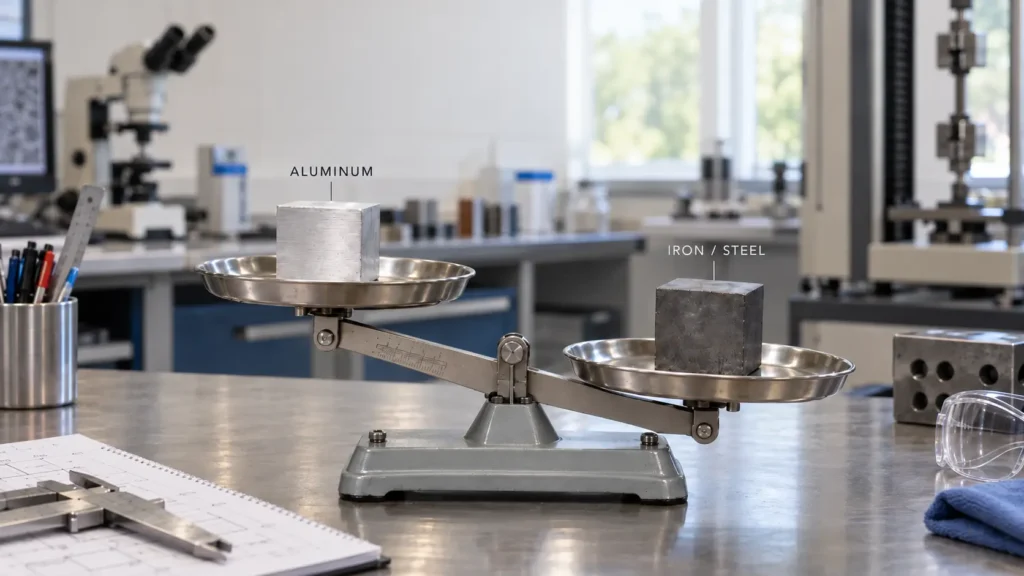
Density describes: How much mass is contained in a given volume of material. The basic formula is: Density = Mass ÷ Volume or: ρ = m / V. For example, the density of common carbon steel is approximately: 7.85 g/cm³. This means that a solid steel block with a volume of 1 cm³ weighs approximately 7.85 g.
If the same volume is made from AL5052 aluminum, it weighs only about: 2.68 g. So density can simply be understood as: The difference in weight between materials of the same volume.
2. Common Sheet Metal and Stamping Material Density Chart
Density is commonly expressed in g/cm³, kg/m³, and lb/in³. These units describe the same physical property but are used in different measurement systems. The basic conversions are:
- 1 g/cm³ = 1,000 kg/m³
- 1 g/cm³ ≈ 0.03613 lb/in³
- 1 lb/in³ ≈ 27.68 g/cm³
This means the density value is the same physically; only the unit of expression changes.
The table below lists typical density values for materials commonly used in sheet metal fabrication and metal stamping.
| Material | Typical Grade | g/cm³ | kg/m³ | lb/in³ |
|---|---|---|---|---|
| Cold Rolled Steel | SPCC | 7.85 | 7,850 | 0.284 |
| Hot-Dip Galvanized Steel | SGCC | ≈7.85 | ≈7,850 | ≈0.284 |
| Electro-Galvanized Steel | SECC | ≈7.85 | ≈7,850 | ≈0.284 |
| Stainless Steel | SUS304 | ≈7.93 | ≈7,930 | ≈0.287 |
| Stainless Steel | SUS316 / 316L | ≈8.00 | ≈8,000 | ≈0.289 |
| Aluminum | AL1050 | ≈2.71 | ≈2,710 | ≈0.0979 |
| Aluminum | AL1060 | ≈2.71 | ≈2,710 | ≈0.0979 |
| Aluminum | AL5052 | 2.68 | 2,680 | 0.0968 |
| Aluminum | AL6061 | ≈2.70 | ≈2,700 | ≈0.0975 |
| Brass | C26000 / CuZn30 | ≈8.53 | ≈8,530 | ≈0.308 |
| Phosphor Bronze | C5191 / C51900 | ≈8.84 | ≈8,840 | ≈0.319 |
| Copper | C1100 / C11000 | ≈8.89–8.91 | ≈8,890–8,910 | ≈0.321–0.322 |
Note: The values above are typical reference densities. Actual density may vary slightly depending on alloy composition, material standard, temper, and specific grade.
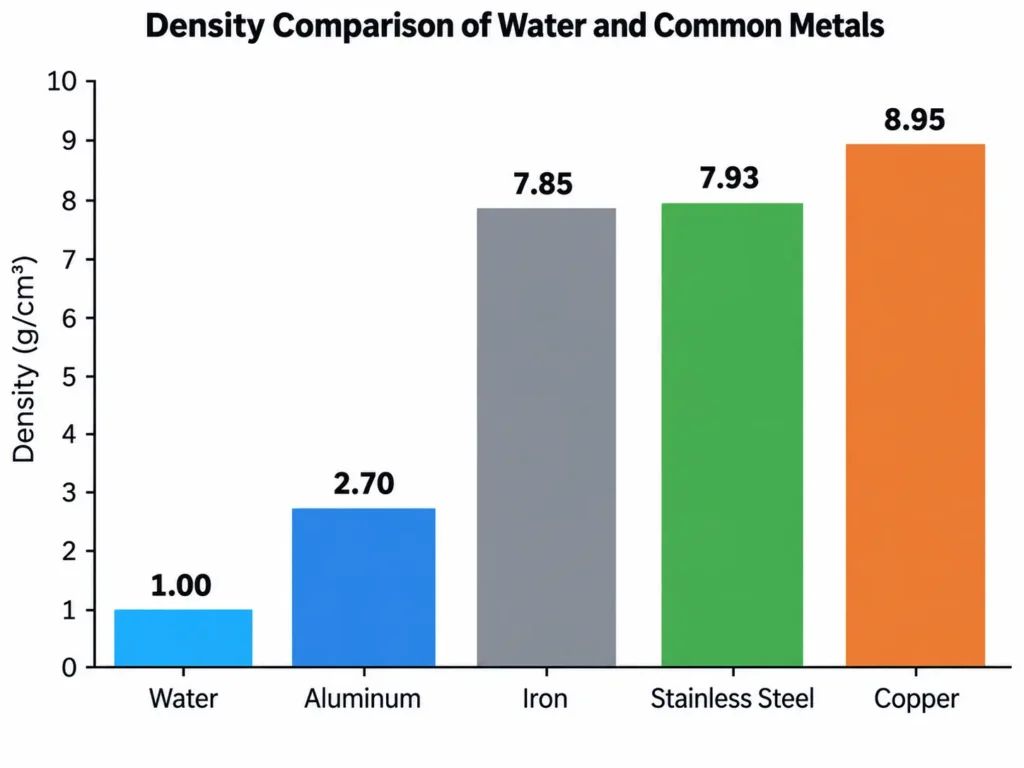
For the same volume, steel is about 7.85 times denser than water, while aluminum is about 2.7 times denser than water.
Frequently Asked Questions
The typical density of carbon steel and cold rolled steel is approximately 7.85 g/cm³, or 7,850 kg/m³. This value is commonly used for SPCC and general steel weight calculations.
The density of aluminum is typically around 2.7 g/cm³, or 2,700 kg/m³. Different aluminum alloys vary slightly; for example, AL5052 is about 2.68 g/cm³, while AL1050 and AL1060 are about 2.71 g/cm³.
The typical density of SUS304 stainless steel is approximately 7.93 g/cm³, or 7,930 kg/m³. Other stainless steel grades may have slightly different densities.
Different metal grades contain different proportions of alloying elements such as iron, chromium, nickel, copper, zinc, and magnesium. These differences in chemical composition cause the density to vary from one alloy grade to another.
To convert density units: g/cm³ to kg/m³: multiply by 1,000; g/cm³ to lb/in³: multiply by 0.03613. For example, steel has a density of 7.85 g/cm³:
7.85 × 1,000 = 7,850 kg/m³
7.85 × 0.03613 ≈ 0.284 lb/in³
So:
7.85 g/cm³ = 7,850 kg/m³ ≈ 0.284 lb/in³
These values represent the same material density expressed in different measurement systems.