1. What Is Metal Drilling?
Metal drilling is a machining process used to create round holes in a workpiece. A rotating drill bit cuts the material while moving into the part along its axis. Drilling is widely used for screw holes, locating holes, tapping preparation and component assembly.
The terms are easy to confuse. A drill may refer to the machine or hand tool. Drilling is the cutting process, while a drill bit is the cutting tool that produces the hole.
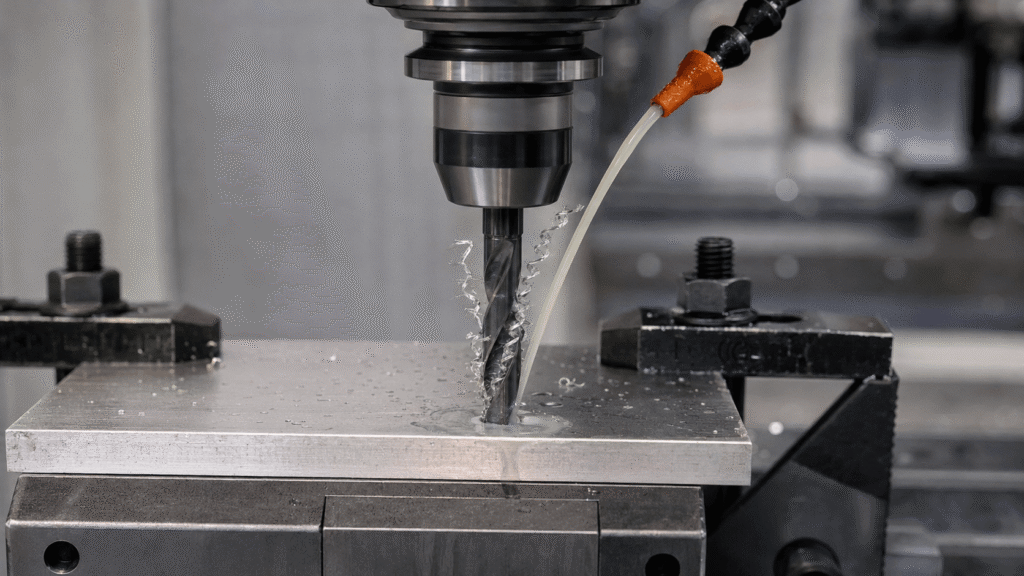
A twist drill cuts into a securely clamped aluminum plate while coolant controls heat and helps remove chips.
2. How Metal Drilling Works
A typical twist drill has two cutting lips at its tip. As the spindle rotates, these cutting edges remove material from the bottom of the hole. At the same time, the drill moves downward at a controlled feed rate.
The spiral flutes carry chips upward and away from the cutting area. Cutting fluid may also reduce heat, improve lubrication and support chip evacuation. Poor chip removal can damage the hole surface, increase tool wear or even break the drill.
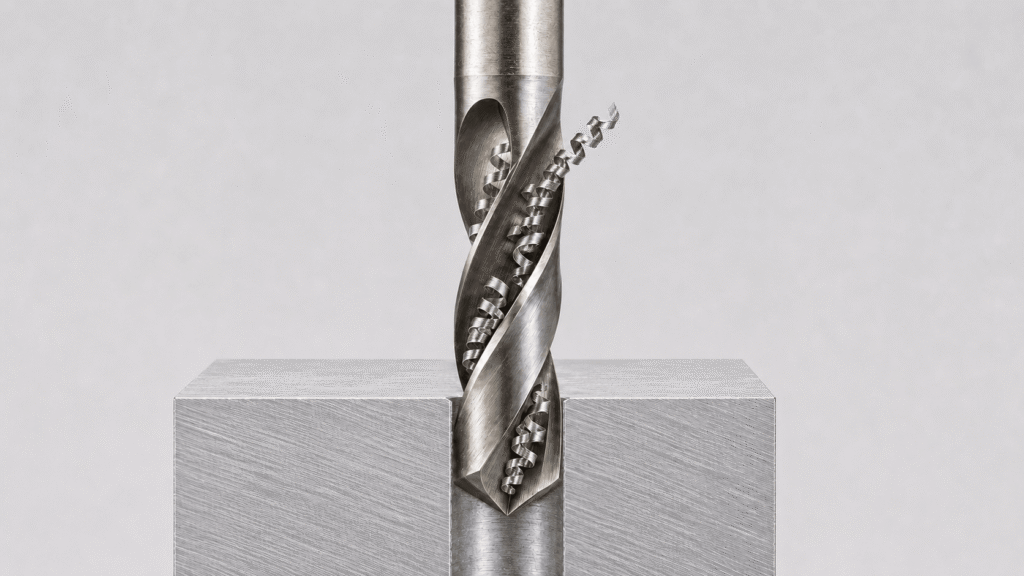
Rotation provides the cutting action, feed moves the drill into the workpiece, and the flutes carry chips away from the hole.
The main drilling parameters are:
- Cutting speed: Controls how fast the drill rotates relative to the material.
- Feed rate: Controls how quickly the drill moves into the workpiece.
- Coolant supply: Reduces heat and helps clear chips from the flutes.
- Tool runout: Excessive runout may create an oversized or uneven hole.
- Setup rigidity: A stable machine, tool holder and fixture reduce vibration and drill deflection.
Chip formation and evacuation are especially important in metal drilling. Chip jamming may reduce hole quality and damage the tool. More technical information is available in the Sandvik Coromant drilling guide.
3. Choosing Drill Bits and Hole Types
The correct drill bit depends on the workpiece material, hole diameter, depth, tolerance and production quantity.
| Drill material | Typical use | Main characteristic |
|---|---|---|
| High-speed steel | General steel, aluminum and low-volume work | Economical and relatively tough |
| Cobalt high-speed steel | Stainless steel and materials that generate more heat | Better heat and wear resistance than standard HSS |
| Solid carbide | CNC machining, higher production speeds and improved accuracy | Rigid and wear-resistant, but more sensitive to vibration and impact |
A standard twist drill can produce both through holes and blind holes. A through hole passes completely through the workpiece. A blind hole stops at a specified depth, so the drawing should clearly define the required depth.
If the hole needs a tighter tolerance or better surface finish, drilling may be followed by reaming or boring. Tapping creates an internal thread, while countersinking or counterboring prepares the hole for a specific screw head.
4. Controlling Hole Quality
Hole quality includes more than diameter. The manufacturer should also check position, roundness, straightness, depth, surface finish and burr condition. Burrs usually form where the drill exits the material, especially on thin sheet metal or when the tool is worn.
Common problems include oversized holes, rough internal surfaces, drill wandering, heavy exit burrs and broken tools. These problems may result from incorrect speed or feed, poor chip evacuation, excessive runout, insufficient coolant or an unstable setup.
For consistent results, use the shortest practical drill and clamp the workpiece securely. Select cutting data for the actual material, then inspect the drill edges and chips during production. Critical holes should be measured with suitable gauges or inspection equipment rather than checked only by appearance.
FAQ
Drilling creates a new hole in solid material. Boring enlarges or improves an existing hole and is often used for better accuracy, alignment or surface finish.
No. Many modern CNC drills can start directly on a suitable flat surface. However, a pilot or spot hole may help with deep holes, large drills or unstable entry surfaces.
A drill can produce a good general-purpose hole, but very tight tolerances may require reaming or boring after drilling.
As the drill approaches the bottom surface, the remaining material becomes thin and loses support. The drill may push this material outward before cutting it completely, which creates an exit burr.
Cobalt HSS and solid-carbide drills are common choices. The best option depends on machine rigidity, hole size and production volume. Correct cutting data and reliable coolant supply are also important.
For support with stamped parts, sheet-metal components, CNC machined parts and hole-making operations, please contact us.
📧 sales@innoway-metalparts.com
🌐 www.innoway-metalparts.com
📞 +86 18824570656