WHAT IS NPI?
In the electronics, hardware, and manufacturing industries, NPI (New Product Introduction) serves as the vital bridge connecting “conceptual design” with “mass production.” A highly efficient NPI process not only determines whether a product can be launched on time but also directly impacts product quality and cost control.
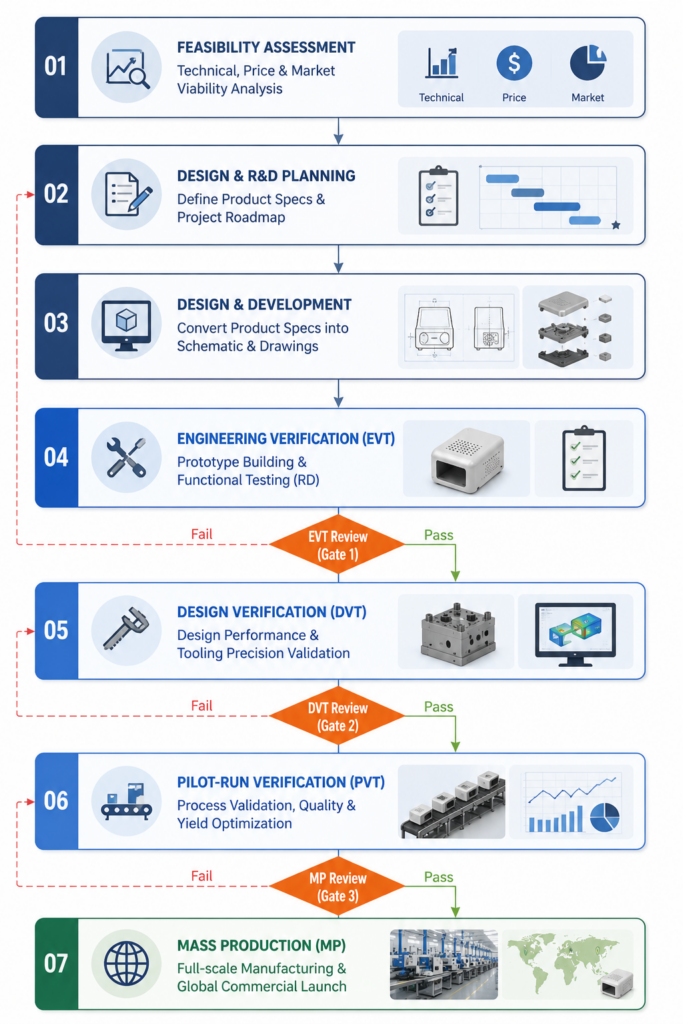
The following is a comprehensive guide to the NPI process, structured into Seven Stages and Three Major Verifications, tailored for your international trade website to showcase your engineering capabilities and rigorous quality control standards to global clients.
Striving for Excellence: A Deep Dive into the 7 Stages & 3 Verifications of NPI
NPI refers to the entire process of transforming a product from a research and development design into its first physical manufacturing run. It encompasses production planning, manufacturing process design, prototyping, pilot runs, and small-batch production.
The Seven Stages of NPI
1. Development Feasibility Assessment
- Definition: A comprehensive analysis of the new product’s technical feasibility, market prospects, target pricing, and estimated total manufacturing costs to ensure the project is commercially and technically viable.
2. Design & Development Planning
- Definition: Clearly defining the core product specifications, functions, and establishing the overall R&D roadmap, timelines, and milestones.
3. Design & Development (R&D)
- Definition: The R&D team translates product specifications into concrete engineering inputs, such as schematics, engineering drawings, and 3D CAD models.
4. Engineering Verification Test (EVT) Stage
- Definition: The first of the Three Major Verifications. This is where engineering drawings and parameters are transformed into the very first physical samples.
- In Practice: The R&D (Research & Development) team conducts comprehensive functional and safety compliance tests on the initial prototypes. Since these are early-stage samples, issues are common, and testing may be repeated multiple times ($N$ times). The focus here is simple: “Does the design actually work, and can the prototype perform its core functions?”
5. Design Verification Test (DVT) Stage
- Definition: The second of the Three Major Verifications. This stage verifies the actual design performance and assesses the product’s manufacturability.
- In Practice: Conducted after resolving the issues identified during the EVT stage. It involves rigorous testing of all signal levels, timings, and full safety certifications. At this point, the product design is basically finalized. It is strictly verified by both the R&D and DQA (Design Quality Assurance) teams.
6. Pilot-run Verification Test (PVT) Stage
- Definition: Also known as the Small-Batch Process Verification stage, this is the third and final Major Verification.
- In Practice: This stage validates the functional implementation of the new model on a real production line while conducting stability and reliability tests. The NPI team must work aggressively to uncover and eliminate any remaining issues. The golden rule of PVT is to ensure that no design flaws or manufacturing process bugs are carried over into mass production.
7. Mass Production (MP)
- Definition: The final stage where the product smoothly transitions into full-scale manufacturing and commercial sales.
- In Practice: Having passed all previous quality gates, the product is cloned efficiently, at high quality, and at optimized costs, fully ready for the global market.
Engineering Note: These seven stages form the standard framework of the NPI workflow. In actual industrial practice, the process can be adjusted and supplemented based on specific industry standards and product complexities.
Standardized NPI Process Flowchart ↓