1. Understanding the V-Die and V-Opening
The V-die is the most commonly used lower die in sheet metal bending. For beginners, there is no need to memorize dozens of tooling models. The first thing to understand is simple:
The V-opening directly affects the bending radius, required tonnage, minimum flange length, and surface condition.
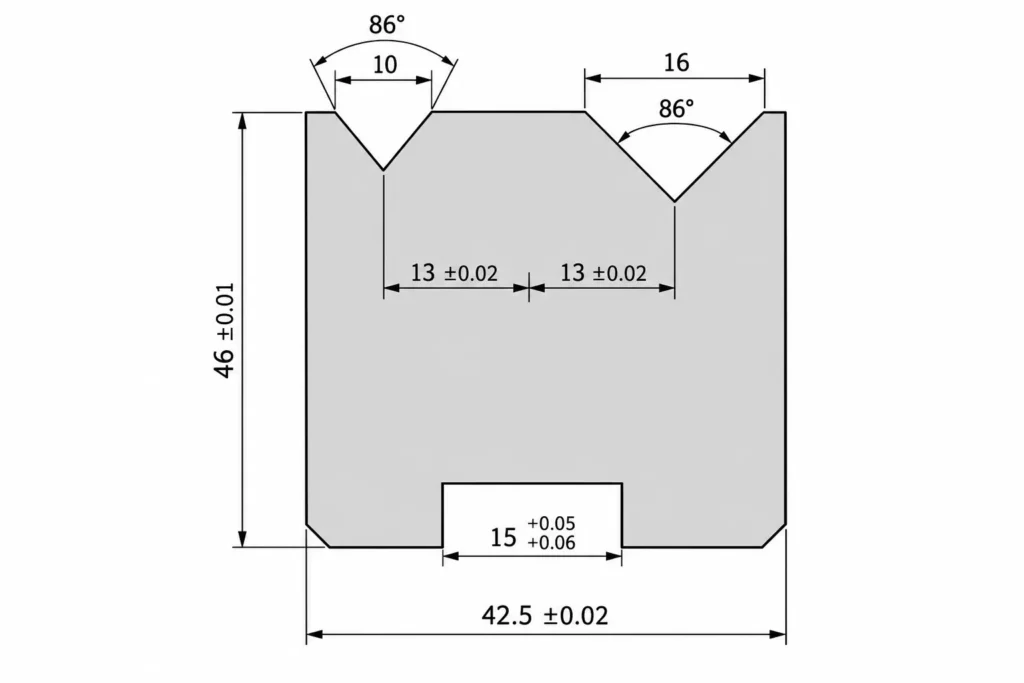
In daily production, terms such as V8, V12, and V16 normally refer to the width of the V-opening.
For example:
- V8 = approximately 8 mm V-opening
- V12 = approximately 12 mm V-opening
- V16 = approximately 16 mm V-opening
So V8 is not simply a tooling number. It tells you the actual opening width of the lower die.
2. What Does the V-Opening Affect?
During air bending, the sheet is supported by the two shoulders of the V-die while the punch moves downward and bends the material between them. The V-opening mainly affects four things: inside bend radius, bending force, minimum flange length, and surface marks.
These four factors are closely connected.
A smaller V-opening usually produces a smaller inside radius and allows shorter flanges, but it also increases bending tonnage and may increase marking or cracking risk.
A larger V-opening reduces the required force and creates a more gradual bend, but the bend radius becomes larger and short flanges may no longer be supported properly.
3. How to Select the V-Opening
For general air bending of mild steel, a useful starting point is: V ≈ 8t, Where:
- V = V-opening width
- t = sheet thickness
Typical starting values are:
| Sheet Thickness | Initial V-Opening |
|---|---|
| 1.0 mm | V8 |
| 1.5 mm | V12 |
| 2.0 mm | V16 |
| 3.0 mm | V20–V25 |
| 4.0 mm | V25–V32 |
This is not a fixed rule. It is a practical starting point. The final choice should still consider: material type, required bend radius, minimum flange length, and machine tonnage.
4. What Happens When the V-Opening Changes?
The relationship is easy to remember.
| V-Opening Change | Typical Result |
|---|---|
| Smaller V-opening | Smaller inside radius |
| Smaller V-opening | Higher bending force |
| Smaller V-opening | Shorter flange possible |
| Smaller V-opening | Higher marking or cracking risk |
| Larger V-opening | Larger inside radius |
| Larger V-opening | Lower bending force |
| Larger V-opening | Longer minimum flange required |
| Larger V-opening | More gradual material deformation |
This explains many common shop-floor decisions. If a flange is too short, a smaller V-opening may be necessary. If the material tends to crack, increasing the V-opening can reduce the severity of deformation. If the machine is approaching its tonnage limit, a larger V-opening may also help reduce the required bending force.
5. V-Opening and Inside Bend Radius
One of the most common mistakes in sheet metal bending is assuming that the final inside radius is determined only by the punch tip radius. That is not true in normal air bending. The material bends naturally across the V-opening, so the lower die has a major influence on the final inside radius.
For mild steel, a useful engineering estimate is: Ri ≈ 0.15–0.17V, For example:
- V12 may produce an inside radius of roughly 1.8–2.0 mm
- V16 may produce an inside radius of roughly 2.4–2.7 mm
These values are only for process estimation. Actual results depend on material strength, sheet thickness, tooling geometry, and bending method.
This is why a drawing that specifies R2 does not automatically mean that an R2 punch should be selected.
6. V-Opening and Minimum Flange Length
Even if a V-opening is suitable for the sheet thickness, it may still be unsuitable for the part geometry. The flange must be long enough to remain supported on the shoulder of the lower die during bending. A practical shop-floor estimate is: Minimum flange length ≈ 0.7V, For example:
- V8 requires roughly 5.5–6 mm minimum flange length
- V16 requires roughly 11–12 mm
This is especially important when the drawing contains short return flanges or narrow edges. For example, a 2.0 mm mild steel sheet may normally work well with V16.
However, if the part only has an 8 mm flange, V16 may be too large. A smaller V-opening may be required, but once the V-opening is reduced, the engineer must recheck: bending tonnage, bend radius, surface marking, and cracking risk.
7. Different Materials Need Different Judgment
The V≈8t rule is most useful as a reference for mild steel. Other materials require additional judgment.
Stainless steel generally has higher strength and greater springback, so it often requires more bending force.
Aluminum alloys require more attention to cracking, especially in harder tempers. If the V-opening is too small and the bend radius becomes too tight, the outer surface can crack.
Conclusion
To understand V-dies, remember these core rules:
V8, V12, and V16 refer to the V-opening width.
For mild steel air bending, V≈8t is a useful starting point.
A smaller V-opening gives a smaller bend radius and allows shorter flanges, but increases tonnage and deformation severity.
A larger V-opening reduces tonnage but increases the inside radius and minimum flange requirement.
FAQ
V8 normally means that the lower die has a V-opening of approximately 8 mm. The number refers to the opening width, not simply the tooling model number.
For general air bending of 1.0 mm mild steel, V8 is a common starting point. The final choice should still consider bend radius, flange length, material type, and surface requirements.
In air bending, yes. A smaller V-opening normally produces a smaller natural inside bend radius, but it also increases bending force and may increase cracking or surface marking.
A larger V-opening reduces tonnage, but it also increases the bend radius and the minimum flange length required. Short flanges may lose support and become difficult or impossible to bend correctly.
In air bending, both tooling geometry and material behavior matter, but the V-opening has a major influence on the natural inside radius. The final radius should not be judged from the punch tip radius alone.