Surface treatment quality is one of the most critical — and often overlooked — factors in the long-term performance of precision stamped and sheet metal components. Salt spray testing (also known as salt fog testing) is the globally accepted method for evaluating a part’s resistance to corrosion under accelerated conditions. At Innoway, we conduct this testing in-house to help our customers validate surface quality before mass production.
What Is Neutral Salt Spray (NSS) Testing?
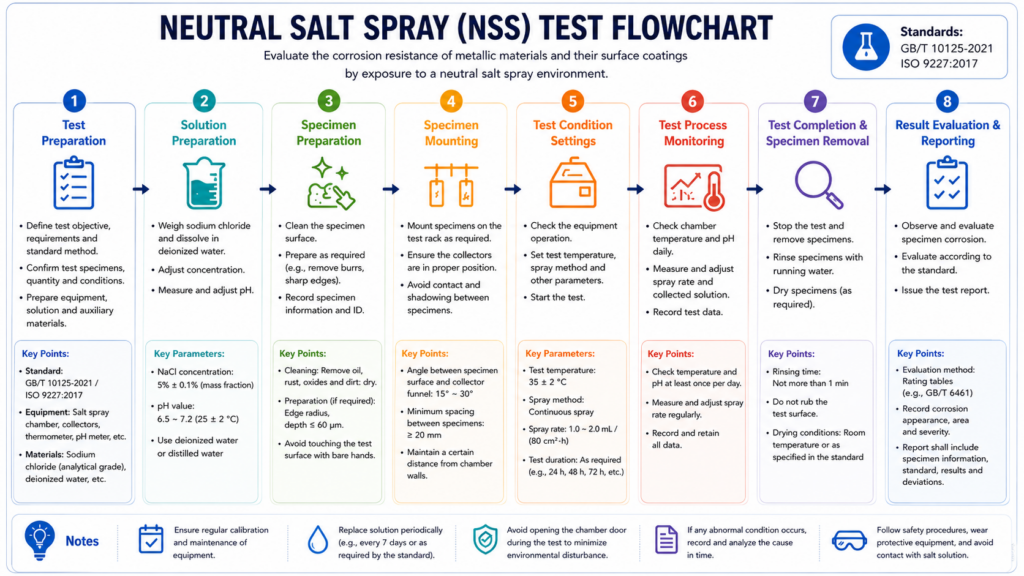
Neutral Salt Spray (NSS) testing simulates a corrosive, salt-laden environment to evaluate how well a metal part — and its surface treatment — resists oxidation and corrosion over time. It is governed by internationally recognized standards including ASTM B117, ISO 9227, and GB/T 2423.17.
NSS Test Parameters
The following conditions are maintained throughout the test to ensure consistency and repeatability:
| Parameter | Specification |
|---|---|
| Salt Solution | 5% ± 1% NaCl (sodium chloride) in distilled water |
| Solution pH | 6.5 – 7.2 |
| Chamber Temperature | 35°C ± 2°C (95°F ± 4°F) |
| Spray Pressure | 70 – 170 kPa |
| Spray Rate (collection) | 1.0 – 2.0 mL/80cm²/hr |
| Test Duration | 24h / 48h / 96h / 240h / 500h / 1000h+ (per requirement) |
| Sample Placement Angle | 15° – 30° from vertical |
How Is the Result Judged? Industry Pass/Fail Criteria
Evaluation after the test is based on visual inspection and comparison against defined acceptance criteria. Common industry standards are as follows:
| Failure Mode | Typical Acceptance Criterion |
|---|---|
| Red rust (base metal corrosion) | Zero red rust within specified test duration |
| White rust (zinc/aluminum oxidation) | ≤ 5% surface coverage (varies by standard) |
| Blistering / peeling of coating | None allowed in primary surface area |
| Corrosion at scribed line | Creep ≤ 1–2 mm from scribe (per ISO 9227) |
| Dimensional change / function loss | No functional impairment allowed |
Note: Acceptance criteria vary depending on the applicable standard, industry (automotive, consumer electronics, industrial), and customer specifications. We align test requirements with our customers’ target standards before testing begins.
Which Surface Treatments Can Be Tested?
Salt spray testing is applicable across a wide range of surface finishes we offer: 1. Electroplating (zinc, nickel, chrome, tin); 2. Powder coating and liquid paint; 3. Anodizing (aluminum parts); 4. Phosphating + painting (multi-layer protection); 5. Passivation (stainless steel).
Our In-House Testing Capability
We operate a dedicated salt spray test chamber and can conduct NSS testing to ASTM B117 / ISO 9227 or customer-defined standards. Formal test reports are issued for each batch, supporting your supplier qualification, customer audits, or product certification requirements.
Having this capability in-house means: 1. Faster turnaround — no waiting for third-party labs; 2. Integrated quality control — tested before shipment, not after complaints; 3. Direct engineering communication — if a part fails, we investigate and resolve at the source.
* Neutral Salt Spray Test Flowchart *
Watch: Salt Spray Test in Action