Getting an accurate sheet metal fabrication quote starts with a clear and complete RFQ (Request for Quotation).
For buyers and engineers, providing the right information at the beginning can significantly reduce back-and-forth communication, shorten quotation time, and help manufacturers select the most suitable production process.
Whether you need prototypes, small batches, or mass production, this guide explains what information should be included in a sheet metal RFQ and how Innoway reviews a project before quotation.
1. What Information Is Required for a Sheet Metal RFQ?
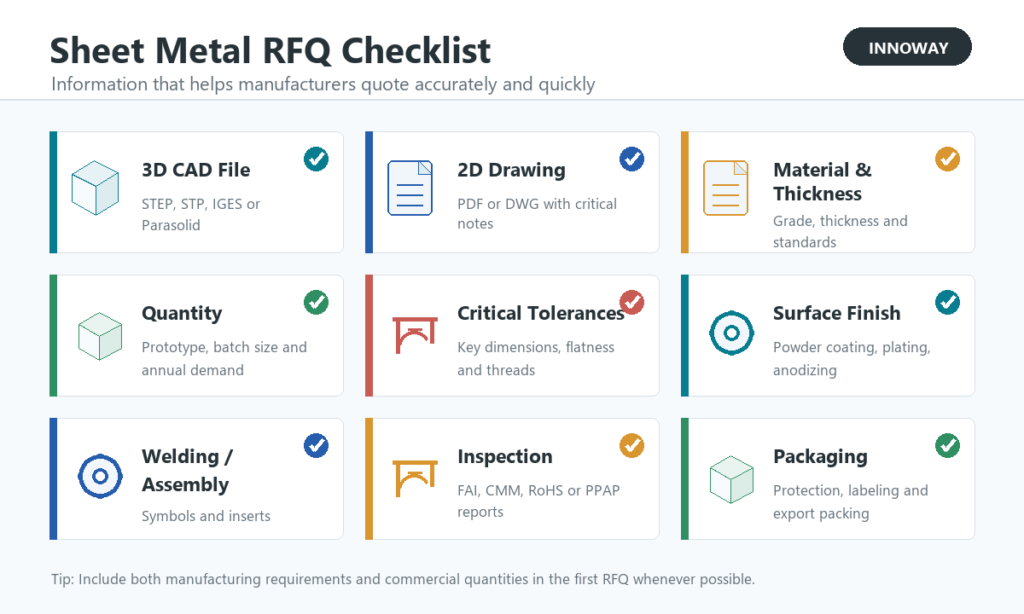
A complete RFQ allows the manufacturer to understand not only the shape of the part, but also its material, manufacturing requirements, quality standards, and expected production volume.
For most sheet metal and stamping projects, we recommend providing:
- 3D CAD files such as STEP, STP, IGES, or Parasolid
- 2D engineering drawings in PDF or DWG format
- Material grade
- Material thickness
- Required quantity
- Annual estimated demand
- Surface finish
- Dimensional and geometric tolerances
- Welding or assembly requirements
- Inspection requirements
- Packaging requirements
The more complete the information, the easier it is for the manufacturer to provide an accurate and realistic quotation.
2. Why Should You Provide Both 2D Drawings and 3D Models?
One of the most common RFQ problems is receiving only a 3D model without a detailed engineering drawing.
A 3D model is useful for understanding:
- Overall geometry
- Part shape
- Hole locations
- Bends
- Assembly relationships
However, a 3D model normally does not contain all manufacturing requirements.
A 2D drawing can define important information such as:
- Critical tolerances
- Flatness
- Position tolerance
- Thread specifications
- Welding symbols
- Surface finish
- Coating requirements
- Inspection points
- Special notes
For this reason, providing both a 3D model and a 2D drawing usually results in a faster and more accurate quotation.
If only a 3D file is available during the early design stage, the manufacturer can still perform an initial DFM review, but additional technical information may be required before production.
3. Clearly Specify Material and Thickness
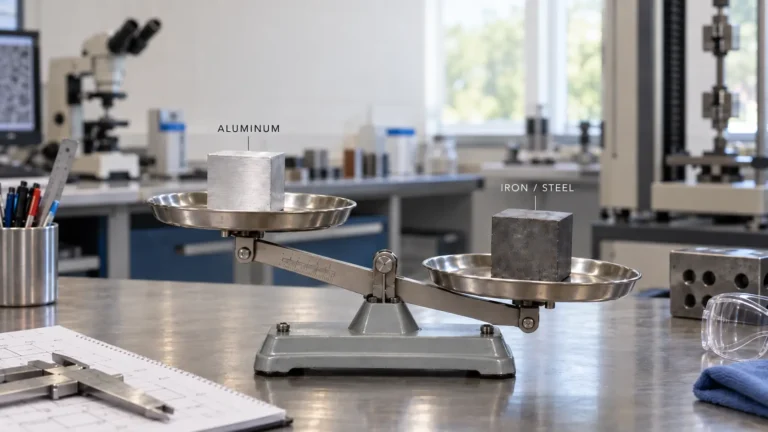
Material selection has a direct impact on cost, manufacturability, strength, corrosion resistance, appearance, and surface treatment.
Common materials used in sheet metal fabrication include:
| Material | Common Applications |
|---|---|
| SPCC / Cold Rolled Steel | Brackets, housings, structural parts |
| SGCC / Galvanized Steel | Electrical cabinets, industrial components |
| SUS304 Stainless Steel | Equipment, food machinery, general industrial parts |
| SUS316L Stainless Steel | Marine, medical and corrosion-resistant applications |
| Aluminum 5052 | Covers, brackets, enclosures and lightweight structures |
| Aluminum 6061 | CNC machined and structural components |
| Copper | Electrical and thermal applications |
| Brass | Decorative and electrical components |
Material thickness must also be specified clearly.
For example:
AL5052-H32, t = 1.5 mm, is much more useful than simply writing: Aluminum
Different materials and thicknesses may require different tooling, bending parameters, welding processes, and production methods.
4. Which Tolerances Actually Matter?
Tolerance is one of the most important factors affecting manufacturing cost.
Not every dimension needs an extremely tight tolerance.
For example, a general bracket may not require ±0.05 mm on every dimension. Applying unnecessary tight tolerances may increase:
- Machining time
- Tooling requirements
- Inspection time
- Scrap rate
- Production cost
A better approach is to clearly identify critical dimensions that directly affect:
- Assembly
- Product function
- Appearance
- Sealing
- Positioning
- Mating components
General dimensions can follow a standard tolerance such as ISO 2768, while tighter tolerances are applied only where necessary.
If you are unsure which tolerances are realistic for stamping, bending, CNC machining, or welding, a DFM review before quotation can help identify potential issues.
5. Clearly Define Surface Finish Requirements
Surface treatment is another important part of a sheet metal quotation.
Different finishes have different costs, appearance standards, corrosion resistance, and production requirements.
Common surface finishes include:
- Powder coating
- Wet painting
- Anodizing
- Electroplating
- Electrophoresis / E-coating
- Brushing
- Polishing
- Sandblasting
- Passivation
- Laser marking
- Silkscreen printing
- Pad printing
When requesting a quotation, avoid simply writing: Black finish. Instead, provide more specific information such as: Black powder coating, matte finish, RAL 9005 or: Black anodizing, matte appearance
For cosmetic components, it is also helpful to define:
- Gloss level
- Texture
- Color standard
- Appearance acceptance criteria
- Masking areas
- Areas where coating is not allowed
6. Prototype Quantity vs. Mass Production Quantity
Quantity can significantly affect the manufacturing process and quotation.
For example, producing 10 pieces and producing 50,000 pieces of the same part may require completely different manufacturing strategies.
6.1 Prototype Production
For prototypes or low-volume production, manufacturers may use:
- Laser cutting
- CNC punching
- Press brake bending
- CNC machining
- Simple fixtures
- Manual welding
The tooling investment is relatively low, but the unit cost is normally higher.
6.2 Medium-Volume Production
For several hundred or several thousand pieces, manufacturers may introduce:
- Dedicated fixtures
- Simple stamping tools
- Semi-automatic production
- Optimized nesting
- More efficient inspection methods
6.3 Mass Production
For high-volume production, progressive dies or dedicated stamping tooling may become more economical.
Although tooling requires an initial investment, it can significantly reduce:
- Cycle time
- Unit cost
- Labor cost
- Production variation
Therefore, when requesting a quote, we recommend providing both the initial order quantity and the estimated annual demand.
For example:
First order: 500 pcs
Estimated annual demand: 30,000 pcs
This allows the manufacturer to evaluate the most economical production method instead of quoting only for the first batch.
7. Common RFQ Mistakes That Delay a Quote
Many quotation delays are caused by missing or unclear information. Here are some common examples.
7.1 Missing Material Grade
Writing only “stainless steel” is not sufficient. SUS304 and SUS316L can have significantly different material costs.
7.2 Missing Material Thickness
Material thickness affects cutting, stamping, bending, welding, and tooling.
7.3 Only Providing a 3D Model
Without a 2D drawing, important tolerances, threads, surface finishes, and quality requirements may be missing.
7.4 Unclear Surface Finish
“Black coating” can mean powder coating, painting, anodizing, electrophoresis, or another process.
7.5 No Quantity Information
Manufacturing 20 pieces and 20,000 pieces requires different production planning.
7.6 Welding Requirements Are Not Defined
Weld type, location, appearance requirements, penetration, grinding, and deformation control should be clearly specified where necessary.
7.7 Packaging Requirements Are Missing
Individual protective packaging, export cartons, pallets, PE bags, foam, protective film, or custom packaging can affect the final quotation. Providing these details at the RFQ stage helps avoid quotation revisions later.
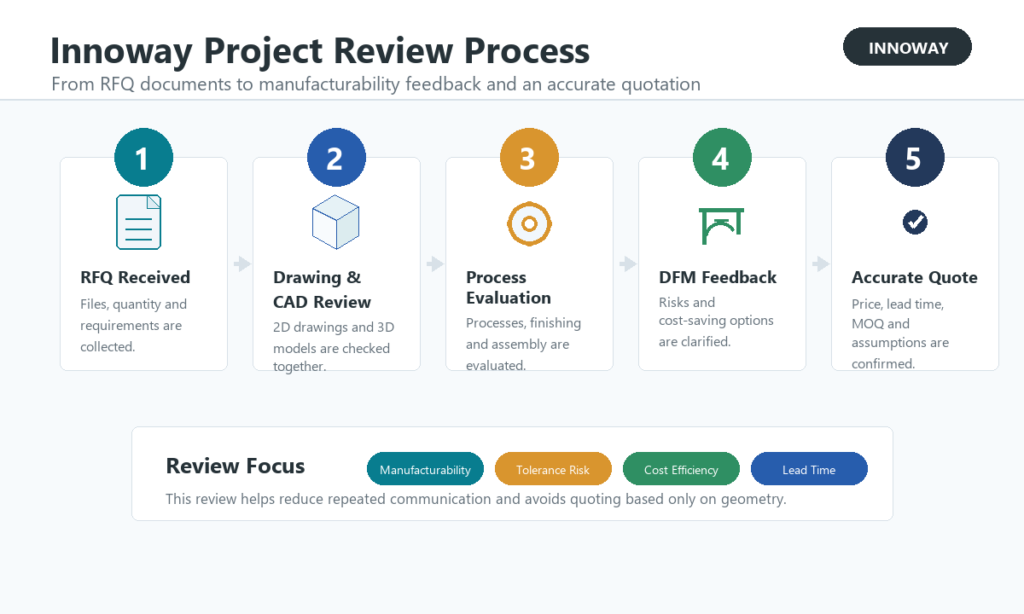
8. How Innoway Reviews Your Project Before Quoting
At Innoway, quotation is not simply based on material weight and processing time. Before preparing a quotation, our engineering team reviews the complete manufacturing process. A typical review includes:
Step 1: Drawing and DFM Review
We review the 2D and 3D drawings to identify potential manufacturing risks, such as:
- Bend interference
- Hole-to-edge distance
- Hole-to-bend distance
- Excessively tight tolerances
- Difficult welding positions
- Unnecessary machining features
Step 2: Material Review
We confirm:
- Material specification
- Thickness
- Availability
- Material utilization
- Alternative material options where applicable
Step 3: Process Planning
Depending on part geometry and quantity, the process may include:
Laser Cutting → Stamping → Bending → CNC Machining → Welding → Grinding → Surface Treatment → Assembly
Not every part requires every process. The goal is to select the most efficient manufacturing route.
Step 4: Tooling Evaluation
For stamping projects, we evaluate whether the part is more suitable for:
- Prototype tooling
- Single-stage tooling
- Compound tooling
- Progressive dies
Tooling decisions are closely related to annual production volume.
Step 5: Surface Treatment Review
We confirm coating type, appearance requirements, masking areas, color standards, and required performance tests.
Step 6: Inspection Planning
Critical dimensions and quality requirements are identified before production.
Inspection may include:
- Caliper measurement
- Height gauge inspection
- CMM inspection
- Go/No-Go gauges
- Surface inspection
- Coating thickness measurement
- Salt spray testing
- Functional assembly inspection
Step 7: Packaging Review
Finally, the packaging method is reviewed according to part appearance, shipping method, and customer requirements.
9. How to Get a Faster and More Accurate Quote
Before sending your next RFQ, use this simple checklist:
- Prepare your 3D CAD model
- Attach the latest 2D engineering drawing
- Specify material grade
- Specify material thickness
- Provide required quantity
- Provide estimated annual demand if available
- Define critical tolerances
- Specify surface finish
- Specify welding and assembly requirements
- Provide inspection requirements
- Provide packaging requirements
A complete RFQ allows both the buyer and manufacturer to spend less time clarifying basic information and more time optimizing the product.
Have a Sheet Metal or Stamping Project?
Innoway provides custom manufacturing services including:
- Metal stamping
- Sheet metal fabrication
- CNC machining
- Laser cutting
- Bending
- Welding
- Surface finishing
- Laser marking
- Silkscreen printing
- Sub-assembly and packaging
From prototypes to mass production, our engineering team can review your drawing and provide DFM suggestions before quotation.
Send us your 2D and 3D drawings for DFM review and quotation.
Frequently Asked Questions
1. What files should I send for a sheet metal fabrication quote?
We recommend providing both a 3D CAD model such as STEP or STP and a 2D engineering drawing in PDF or DWG format. The 3D model defines part geometry, while the 2D drawing defines tolerances, surface finishes, threads, welding requirements, and other specifications.
2. Can I get a quote if I only have a 3D model?
Yes. An initial quotation or DFM review may be possible with only a 3D model. However, additional information such as material, tolerance, surface finish, quantity, and special requirements may still be required before production.
3. Why does production quantity affect the unit price?
Low-volume production often uses flexible processes such as laser cutting and bending, while high-volume production may use dedicated stamping dies, fixtures, and automated processes. Higher quantities can reduce unit manufacturing cost.
4. Should every dimension have a tight tolerance?
No. Tight tolerances should normally be applied only to dimensions that affect function, assembly, or product performance. Unnecessary tight tolerances can increase manufacturing and inspection costs.
5. What information is required for surface treatment quotation?
You should specify the finish type, color, texture or gloss level, cosmetic requirements, masking areas, coating thickness, and any required tests such as salt spray testing.
6. Can Innoway provide DFM suggestions before production?
Yes. Our engineering team can review your drawings and identify potential manufacturing issues related to stamping, bending, welding, machining, tolerances, materials, and surface treatments before production.