1. What Is Wire EDM?
Wire EDM, short for Wire Electrical Discharge Machining, is one of the most important precision machining processes used in toolmaking, stamping dies, and complex metal component manufacturing.
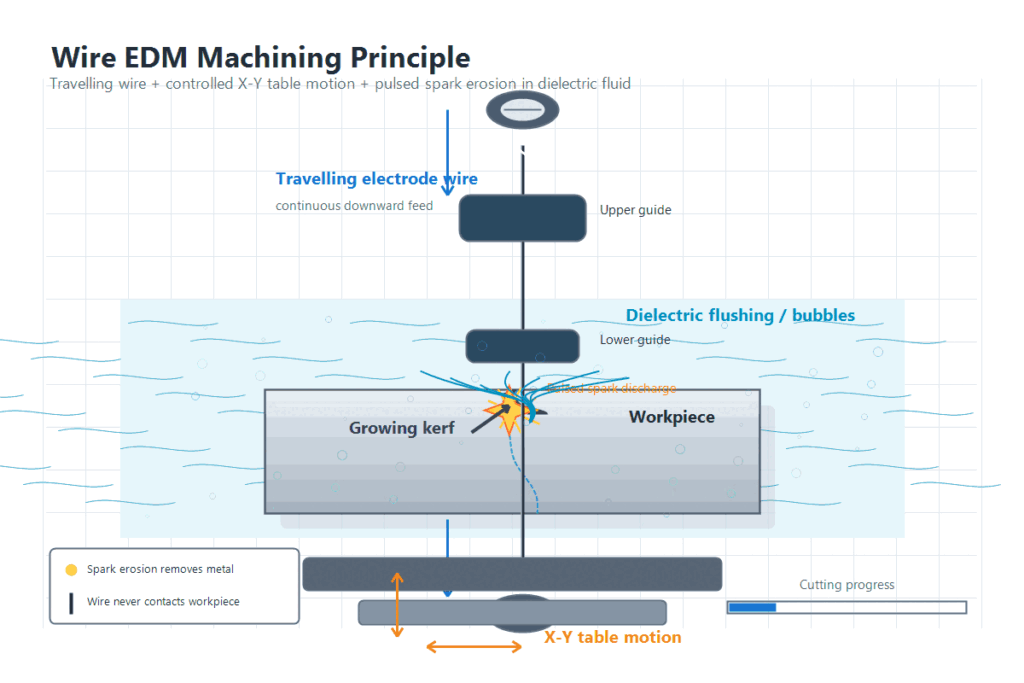
Wire EDM is a non-contact machining process used to cut electrically conductive materials. During machining, a thin metal wire continuously travels between upper and lower guides. The wire acts as an electrode but does not normally touch the workpiece directly.
A controlled electrical discharge occurs across the small gap between the wire and the metal surface. The extremely high local temperature melts and vaporizes tiny amounts of material. These particles are then flushed away by dielectric fluid. The wire follows a CNC-programmed path until the required profile is completed. A typical process may include:
CAD Drawing → Programming → Wire Threading → Rough Cut → Skim Cutting → Inspection
Because the cutting force is extremely low, Wire EDM can maintain excellent dimensional stability even when machining thin, delicate, or hardened components.
2. How Does Wire EDM Work?
A typical Wire EDM system consists of: Wire electrode, CNC control system, Pulse power supply, Upper and lower wire guides, Precision worktable, Dielectric fluid system, Filtration and flushing system.
Common wire materials include: Brass wire, Coated brass wire, Copper-based wire, Molybdenum wire.
During machining, electrical sparks repeatedly occur between the wire and the workpiece. Each spark removes a microscopic amount of metal. Millions of controlled discharges gradually form the required contour.
Because the process relies on electrical discharge rather than cutting-tool hardness, Wire EDM can machine materials that are difficult to process using conventional milling.
3. What Materials Can Wire EDM Cut?
The most important requirement is simple: The material must be electrically conductive.
Common Wire EDM materials include:
| Material | Typical Applications |
|---|---|
| Tool Steel | Stamping dies, inserts, tooling |
| D2 / SKD11 | Punches, die inserts |
| High-Speed Steel | Precision tooling |
| Stainless Steel | Precision components |
| Carbon Steel | Mechanical parts |
| Aluminum | Precision metal components |
| Copper | Electrodes and electrical parts |
| Brass | Precision components |
| Tungsten Carbide | Wear-resistant tooling |
| Titanium | Aerospace and medical parts |
Conventional Wire EDM is generally not suitable for non-conductive materials such as standard plastics, glass, and most ceramics.
4. How Accurate Is Wire EDM?
High precision is one of the biggest advantages of Wire EDM. Actual machining accuracy depends on several factors, including: Machine capability, Wire diameter, Material thickness, Temperature stability, Cutting parameters, Number of skim cuts, Workpiece clamping, Machine maintenance condition,
Typical industrial Wire EDM capabilities may fall within the following range:
| Item | Typical Capability |
| Dimensional Accuracy | Approx. ±0.005 to ±0.02 mm |
| Wire Diameter | Approx. Ø0.10 to Ø0.30 mm |
| Surface Finish | Approx. Ra 0.8–2.5 μm |
| Cutting Thickness | From thin parts to several hundred millimeters, depending on machine |
High-end precision Wire EDM machines can achieve even tighter tolerances under controlled production conditions. For this reason, Wire EDM is widely used for precision stamping dies, punches, die inserts, and other tooling components.
5. Fast Wire EDM, Medium-Speed Wire EDM, and Slow Wire EDM
Wire EDM is commonly divided into Fast Wire EDM, Medium-Speed Wire EDM, and Slow Wire EDM. The main differences are wire movement, machining accuracy, surface finish, efficiency, and cost.
Fast Wire EDM: commonly uses reusable molybdenum wire traveling back and forth at high speed. Fast Wire EDM is suitable when machining cost and efficiency are more important than extremely high precision.
Medium-speed Wire EDM: is an improved version of fast-wire technology. Medium-Speed Wire EDM provides a good balance between machining cost, dimensional accuracy, and surface finish, making it widely used in general precision tooling.
Slow Wire EDM: normally uses single-pass brass or coated wire. The wire moves continuously in one direction and is not reused. Slow Wire EDM is preferred for high-precision stamping dies, punches, die inserts, and other tooling components where dimensional stability and surface quality are critical.
| Item | Fast Wire EDM | Medium-Speed Wire EDM | Slow Wire EDM |
|---|---|---|---|
| Wire Type | Molybdenum wire | Molybdenum wire | Brass or coated brass wire |
| Wire Movement | High-speed reciprocating | Reciprocating | Continuous one-way feeding |
| Wire Reuse | Yes | Yes | No |
| Cutting Method | Mainly single cutting | Rough cut + multiple skim cuts | Rough cut + multiple precision skim cuts |
| Accuracy | Standard | Medium to high | High |
| Surface Finish | Standard | Better | Excellent |
| Machining Stability | Moderate | Good | Excellent |
| Processing Cost | Low | Medium | High |
| Typical Applications | General molds, fixtures, mechanical parts | Precision molds, die components, tooling | High-precision stamping dies, punches, inserts, connector tooling |
| Best For | Cost-sensitive general machining | Balance between cost and precision | Tight tolerances and high surface-quality requirements |
6. Main Advantages of Wire EDM
6.1 Almost No Mechanical Cutting Force
Conventional CNC machining creates cutting forces between the tool and workpiece. These forces can cause:
- Deformation
- Vibration
- Burrs
- Dimensional variation
Wire EDM has almost no conventional cutting force, which makes it especially suitable for thin-wall parts and precision tooling.
6.2 Excellent for Hardened Materials
Many tooling components are hardened before final finishing. For example:
Rough Machining → Heat Treatment → Wire EDM → Grinding → Final Inspection
Wire EDM allows the final profile to be machined after heat treatment. This helps reduce dimensional errors caused by heat-treatment distortion.
6.3 Excellent for Complex Profiles
Wire EDM is particularly suitable for:
- Narrow slots
- Irregular holes
- Sharp profiles
- Complex internal contours
- Punches
- Die inserts
- Precision tooling
- Gear-like profiles
Many geometries that are difficult to machine with conventional cutting tools can be produced efficiently using Wire EDM.
7. Wire EDM in Stamping Die Manufacturing
Wire EDM plays a critical role in precision stamping die production. Typical components include:
Punches
Precision punches are often Wire EDM machined after heat treatment to achieve final dimensions and accurate cutting profiles.
Die Inserts
Complex die openings and cutting edges can be produced directly using Wire EDM.
Stripper Plates
Precision openings inside stripper plates are frequently machined by Wire EDM.
Progressive Die Components
Wire EDM is widely used for: Piercing stations, Blanking stations, Trimming sections, Die inserts, Precision locating features.
In precision stamping, the quality of Wire EDM machining directly affects: Product dimensions, Burr height, Cutting-edge quality, Punch-to-die clearance, Tool life.
For high-volume stamping, accurate Wire EDM tooling can therefore have a direct impact on long-term production stability.
8. Limitations of Wire EDM
Wire EDM is highly capable, but it is not always the most economical machining method.
Conductive Materials Only
Conventional Wire EDM requires electrically conductive materials.
Slower Material Removal
Wire EDM normally removes material more slowly than CNC milling during large-volume rough machining.
Internal Corner Radius
Wire EDM cannot create a perfectly zero-radius internal corner. The minimum achievable internal radius depends on: Wire diameter, Spark gap, Machine settings, Required tolerance. This should be considered during tooling and component design.
9. Wire EDM vs. CNC Milling
| Item | Wire EDM | CNC Milling |
| Machining Principle | Electrical discharge | Mechanical cutting |
| Cutting Force | Almost none | Present |
| Hardened Materials | Excellent | Tool-dependent |
| Complex Profiles | Excellent | Good |
| Narrow Slots | Excellent | Limited by tool diameter |
| Material Requirement | Conductive materials | Most machinable materials |
| Material Removal Rate | Relatively slower | Generally faster |
| Typical Application | Dies, punches, tooling | General machining |
Wire EDM and CNC milling are not competing technologies. In precision manufacturing, they are often used together. A typical production route may be:
CNC Machining + Heat Treatment + Grinding + Wire EDM
This combination can provide a good balance between machining efficiency, cost, and final accuracy.
10. EDM Cutting vs. Laser Cutting
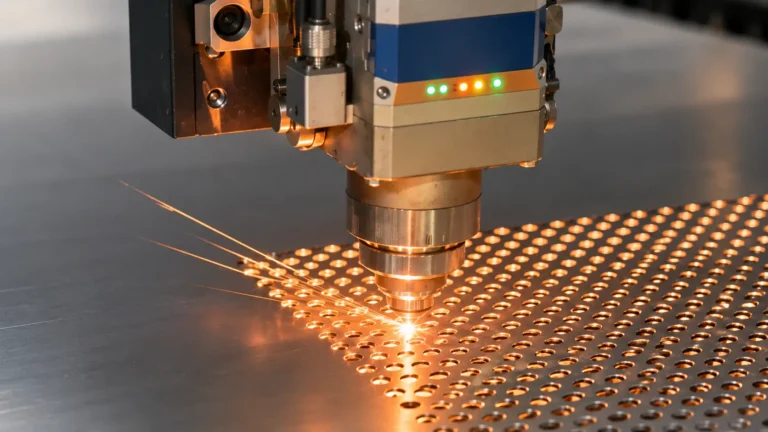
Wire EDM and laser cutting are both widely used for precision metal cutting, but they work in very different ways and are suitable for different applications.
| Item | EDM Cutting | Laser Cutting |
|---|---|---|
| Cutting Principle | Electrical discharge erosion | Focused laser beam melts or vaporizes material |
| Material Requirement | Electrically conductive materials only | Most metals and many non-metal materials |
| Cutting Force | Almost none | Almost none |
| Precision | Very high | High |
| Surface Finish | Excellent | Good |
| Thick Material Capability | Strong | Limited by laser power and material |
| Complex Internal Profiles | Excellent | Good |
| Heat-Affected Zone | Very small | More noticeable |
| Cutting Speed | Relatively slow | Fast |
| Typical Applications | Dies, punches, inserts, precision tooling | Sheet metal parts, enclosures, brackets, panels |
| Best For | Tight tolerances and hardened materials | High-speed sheet metal production |
When to Choose EDM Cutting
EDM cutting is the better choice when the part requires very tight tolerances, hardened materials, narrow slots, complex internal profiles, or high-precision tooling features.
When to Choose Laser Cutting
Laser cutting is more suitable for sheet metal fabrication, larger profiles, high cutting speed, and medium-to-high volume production.
In many manufacturing projects, the two processes are complementary rather than competitive. Laser cutting is often used for fast blank preparation, while Wire EDM is used for high-precision tooling and critical features.
Conclusion
Wire EDM is not primarily designed for high-volume material removal. Its real strength is the machining of high-hardness materials, complex profiles, tight-tolerance components, and precision tooling. It is especially important in the production of:
- Precision stamping dies
- Punches
- Die inserts
- Progressive die components
- Tooling parts
- Complex metal components
For engineers, the best manufacturing solution is often not choosing between Wire EDM and CNC machining. Instead, the goal is to combine processes according to: material condition, heat treatment, tolerance, surface finish, geometry, production volume, and cost.
At Innoway Precision, Wire EDM is integrated with stamping die manufacturing, CNC machining, grinding, and precision inspection to support reliable tooling and metal component production.
Frequently Asked Questions
Wire EDM is commonly used for precision stamping dies, punches, die inserts, tooling components, narrow slots, irregular holes, and complex metal profiles.
Yes. Wire EDM is especially suitable for hardened tool steels because the process does not depend on conventional cutting-tool hardness.
Typical industrial Wire EDM machining may achieve approximately ±0.005 to ±0.02 mm, depending on machine capability, material thickness, cutting conditions, and required finish.
Yes. Aluminum is electrically conductive and can be machined using Wire EDM with suitable machining parameters.
Wire EDM uses electrical discharge and is commonly used for high-precision tooling and thick conductive components. Laser cutting is generally faster and is widely used for sheet metal profile cutting.
Stamping dies often use hardened tool steel and require precise punch-to-die clearance, accurate profiles, and stable dimensions. Wire EDM is therefore highly suitable for producing punches, die openings, and precision inserts.